Why a Snowmobile Corridor Shuts in Summer
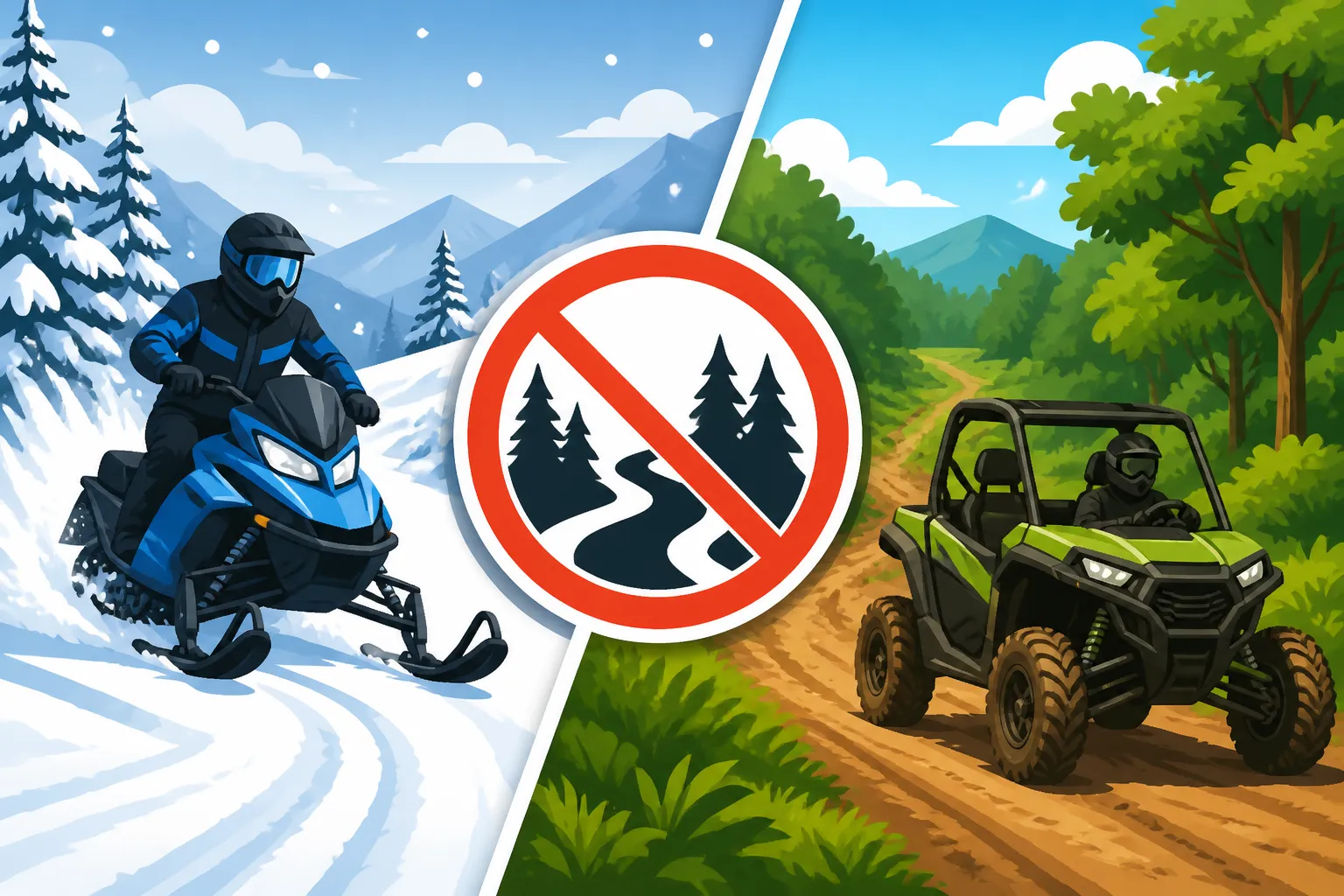
A corridor marked for snowmobiles can look like a ready-made ATV or UTV route once the snow melts. But winter access does not automatically carry over to summer. The trail may cross land open only for snowmobiling, or lack the permission and maintenance needed for wheeled machines. Knowing why corridors close helps you avoid a wrong turn and plan a legal ride.
A winter corridor is not automatically a summer trail
In New Hampshire, a snowmobile corridor describes a route used as part of the snowmobile trail network. It does not, by itself, mean that ATVs and UTVs may use the same route in every season. Summer access depends on whether that specific trail is open to wheeled OHRVs and whether its land access is available for that use.
This distinction is easy to miss. A route may appear on a snowmobile map, connect two towns, and have a wide, well-established trailbed. None of those features proves that it is open to quads or side-by-sides. The landowner’s permission, the club’s arrangements, and the trail’s current status all matter.
Some corridors are used by both snowmobiles in winter and wheeled machines in summer. Others are winter-only, or include sections that cannot be used by OHRVs. Even when one section is open, a connecting section may not be. That is why Trails That Carry Quads in Summer and Sleds in Winter can help clarify how seasonal sharing works, while New Hampshire Rules for a Snowmobile Corridor in Summer addresses the key point: summer access has to be established, not assumed.
Registration and access are separate issues. A valid New Hampshire OHRV registration is generally required when riding where registration applies, but it does not give you permission to use a closed trail or land that is not open to your machine. The same is true of a snowmobile registration: having one does not make a winter corridor a summer OHRV route. New Hampshire does not sell a separate trail pass that overrides a closure; Why Your Registration Is the Access explains the role registration plays, while New Hampshire’s Club Membership and Access covers why club membership and trail access are not the same thing.
Use a practical rule: treat a snowmobile corridor as snowmobile-only unless current information specifically confirms that the section is open to your type of OHRV. If you cannot confirm that, choose a route known to be open rather than trying the corridor and hoping it connects.
Why a snowmobile corridor may close when the snow melts
A winter trail may depend on a different set of conditions and agreements than a summer OHRV trail. Snow can protect the ground and help snowmobiles travel over a prepared surface. When the snow is gone, wheeled traffic can cause a different kind of wear, especially where the trail is wet, soft, or steep.
The reason for a closure is not always one single problem. It may involve landowner permission, ground conditions, trail maintenance, or a section that is simply not designated for summer OHRV use. A club may be able to secure winter access without having permission to operate the same trail for ATVs and UTVs during warmer months. A landowner can also set limits on which vehicles may use the property and when.
| Why access may end after winter | What it means for a rider |
|---|---|
| Permission is seasonal | The landowner or access agreement may allow snowmobiles in winter but not wheeled machines in summer. |
| The ground is vulnerable | A thawing or wet trail can rut, erode, or become difficult to repair under wheeled traffic. |
| The route is not designated for OHRVs | Being a mapped snowmobile route does not establish summer ATV or UTV access. |
| A section has a separate restriction | A connector, bridge, road crossing, or private parcel may be closed even if nearby trail is open. |
| Maintenance is seasonal | The club may not inspect or maintain the route for summer wheeled use. |
| A landowner has withdrawn permission | Access can change, and a closure may affect the only connection between open sections. |
Landowner relationships are especially important in New Hampshire, where many trail routes rely on permission to cross private property. A snowmobile club’s permission for winter use should not be read as year-round permission for every type of vehicle. If a landowner limits access to a season or vehicle category, riders need to follow that limit.
Trail condition is another common concern. Snowmelt and spring rain can leave soil saturated. A wheeled machine can dig ruts that channel water and make future erosion worse. Even a route that is normally open to OHRVs may be closed temporarily during a vulnerable period. New Hampshire’s Mud Season Ban explains why seasonal ground conditions matter, but a mud-season restriction is not the only reason a snowmobile corridor may be unavailable in summer.
A winter corridor may also include infrastructure that serves one purpose in one season but is unsuitable for wheeled traffic in another. A bridge, narrow section, gate, or trail surface may have specific limitations. Never assume that a wide snowmobile route is safe or legal for a UTV. Check any posted restrictions and the route’s current designation.
Most importantly, a closure is not a suggestion to find a way around the barrier. Going around a gate or using a nearby field can put you on land where you do not have permission. It can also damage the very access that makes other trails available. If a route is closed, turn back and use an approved alternate.
How to confirm whether a corridor is open to ATVs and UTVs
Check the status close to the day of your ride. Trail openings can change with weather, maintenance, landowner decisions, or temporary problems. A map is useful for planning, but it may not reflect a recent closure or a seasonal restriction.
Start with information from the local trail club or the organization responsible for the route. Look for a clear statement that the particular section is open to wheeled OHRVs, not just that it is part of a snowmobile corridor. If the map uses different markings for snowmobile and ATV routes, read the legend carefully. When information is unclear, ask the club or an appropriate trail contact before riding.
Use this sequence before you set out:
- Identify the exact trail section. A named corridor can pass through several parcels and connect trails managed by different clubs.
- Check current trail status. Look for seasonal openings, closures, and temporary notices from the relevant club or trail authority. New Hampshire Trail Status Before You Ride is a useful next step.
- Confirm the allowed vehicle type. Verify that ATVs or UTVs are permitted on that section. Snowmobile-only access is not enough.
- Check the dates and conditions. An area may open after a seasonal closure, but close again because of wet conditions, maintenance, or a landowner request.
- Review the route for restrictions. Look for width limits, gates, prohibited connectors, or crossings that may affect your machine.
- Carry a backup route. If a section is closed, do not count on detouring through an unmarked road or private property.
Pay attention to signs at trailheads and along the route. A current closure sign takes precedence over an old map or a route someone rode in a previous season. Do not move, pass, or ride around a barrier. For more on what a closure means in practice, see New Hampshire Rules for Riding a Closed Trail.
If you are planning a trip across several club areas, confirm each section instead of treating the whole corridor as one continuous open trail. Clubs may manage different portions, and an open trail can end at a town line, property boundary, or junction with a closed section. [Sharing a Corridor With Sled Clubs] offers context on how winter and summer use can overlap without being identical.
Also check the rules that apply to your machine and ride. A route’s opening does not waive registration requirements or other operating rules. The machine must meet any applicable requirements, and you still need to follow posted restrictions and ride only where access is allowed. If you are visiting from another state, check New Hampshire’s requirements rather than relying on the registration from home; Riding New Hampshire With an Out-of-State Machine explains that issue.
Planning a ride without relying on a winter route
Build your trip around confirmed OHRV trails, not around a snowmobile map. Once you have a current summer route, check where it begins, whether your machine fits the trail’s width limits, and whether the trail connects to the destination you have in mind. A corridor that appears to provide a shortcut may have a closed connector or a gap that requires a legal road connection.
Keep the route flexible. If a club posts a closure after you have planned the ride, choose another open area rather than treating the closure as an obstacle to get around. Carry a current map or other reliable navigation aid, and make sure riders in your group know where the route changes or ends. A map can help you navigate, but it cannot grant permission to ride a trail that is closed.
If your planned route crosses private land, respect signs, gates, and stated conditions. Written landowner permission is important when riding on private ground outside an authorized trail network. Do not assume that unposted property is open or that permission for winter use also covers summer riding. The articles Written Permission on New Hampshire Private Land and Why Unposted Land Is Not an Invitation explain these boundaries.
For a multi-area trip, contact the relevant clubs before leaving. Ask specifically whether the segment is open to wheeled OHRVs, whether the status is expected to hold for your travel dates, and whether there are restrictions for a wide machine. A concise question about the exact trail section is more useful than asking whether “the corridor” is open, since a long route can contain both open and closed portions.
The main takeaway is straightforward: a snowmobile corridor is a winter route unless its summer OHRV access is confirmed. Check the current status, follow closures, and plan around trails that are explicitly open to your machine. That approach protects landowner access, avoids damage to soft trails, and keeps a seasonal route from turning into an expensive or unsafe detour.
Disclaimer
This article is for general informational purposes only and does not constitute professional advice. Laws, prices and regulations vary by location and change over time. Consult a qualified professional for guidance on your specific situation.