Why Your Registration Is the Access
New Hampshire riders often look for a separate trail pass and wonder whether registration is only paperwork. The distinction matters: registration is required to operate an OHRV off your own property, and New Hampshire has no additional trail user fee. Here’s what that means for ATV and UTV access—and what registration does not authorize.
Why registration is the access
In New Hampshire, registration is not just a record of who owns a machine. It is the required registration for operating an OHRV away from the owner’s property. According to the Town of Newmarket, NH, all snowmobiles and OHRVs must be registered if operated in New Hampshire off the owner’s property. ATVs and UTVs fall under the OHRV category for this purpose.
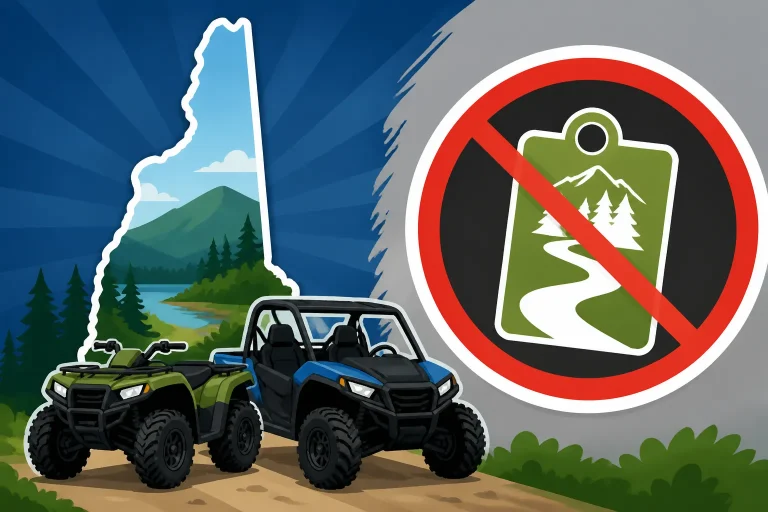
The same source says there are no additional trail user fees in New Hampshire, as of November 2026. In other words, riders should not expect to buy a separate state trail pass on top of registration just to access trails. That is why the registration is often described as the access: it satisfies the registration requirement, rather than serving as an entry ticket for every specific trail or property.
This distinction is useful when you are planning a ride. Registration addresses whether the machine is registered as required; it does not automatically mean every trail is open to you. Access can still depend on the land, the route, local conditions, and whether that trail is open. Do not treat a valid registration as permission to ride anywhere.
For an overview of how the system works, see New Hampshire Permits Explained. The practical takeaway is simple: start by confirming your registration, then check where you can ride. If you are trying to work out whether a separate pass is needed, Do You Need a Trail Pass in New Hampshire? explains the difference between registration and trail access.
| Question | What registration addresses | What you still need to check |
|---|---|---|
| Can you operate an OHRV off your own property? | Whether the machine is registered as required | Whether your intended route is open and available to ride |
| Is there a separate New Hampshire trail user fee? | New Hampshire has no additional trail user fees | Whether a location has its own access conditions |
| Does registration give access to every property? | No; registration is not a blanket permission to ride anywhere | Land access, trail status, and route restrictions |
| Has the machine changed owners? | The new owner must register it in their name | Whether the former registration and decals are still valid |
A registration is therefore necessary, but it is not a universal trail pass. A rider who has registered a machine still needs to plan around closures and access limits. For current information about trails, openings, and closures, the Town of Newmarket, NH, directs riders to the NH Bureau of Trails.
What registration does and does not authorize
A valid registration is one part of being ready to ride. It does not replace checking trail status or confirming that your route is available. A trail may be closed, or a route may cross land where access is not available to you. The sensible approach is to treat registration and trail permission as separate questions: first confirm the machine is registered, then confirm the ride itself is allowed.
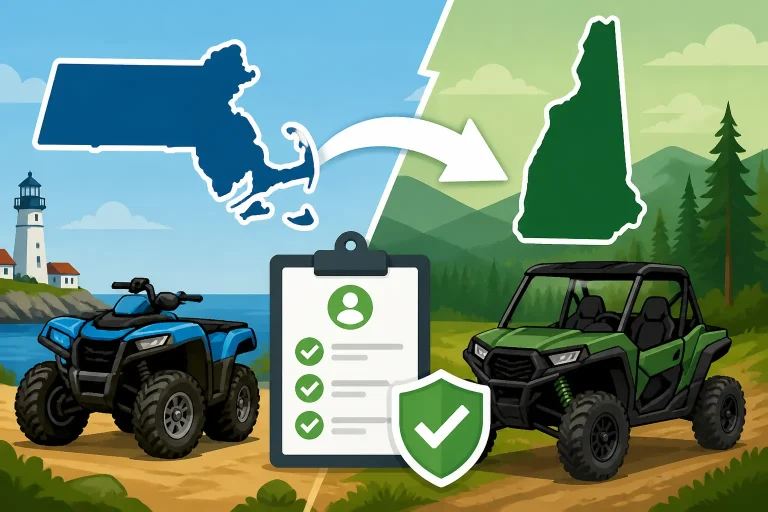
This matters particularly for visitors. Registration in another state does not automatically answer what you need to operate in New Hampshire. If you are coming from elsewhere, review New Hampshire Rules for a Visiting Rider and Registering an Out-of-State Machine in New Hampshire. For a specific question about a Maine registration, see Does New Hampshire Honor a Maine Registration?. Those topics help separate the machine’s home-state paperwork from New Hampshire’s requirements.
The same distinction applies to a machine that has been borrowed, purchased, or kept at a camp. Where you store it does not by itself settle whether it needs registration for the ride you intend to take. The key issue in the Newmarket information is whether an OHRV is operated in New Hampshire off the owner’s property. Before setting out, confirm how that applies to your situation, especially if the machine is not yours or will be used away from its owner’s land.
Registration also does not guarantee that an open trail will remain open for the whole ride. Conditions and closures can change, so check the latest information with the NH Bureau of Trails before relying on a planned route. A useful plan leaves room to change course rather than assuming the registration alone settles every access question.
If you are deciding whether club membership is relevant, keep it separate from the basic question of whether a trail pass exists. The Town of Newmarket, NH, says applicants must present appropriate proof of club membership to qualify for the applicable member rate. That is a registration-rate qualification, not evidence that membership creates permission to ride every trail. See New Hampshire’s Club Membership and Access for more on how membership and access relate.
What to prepare when registering
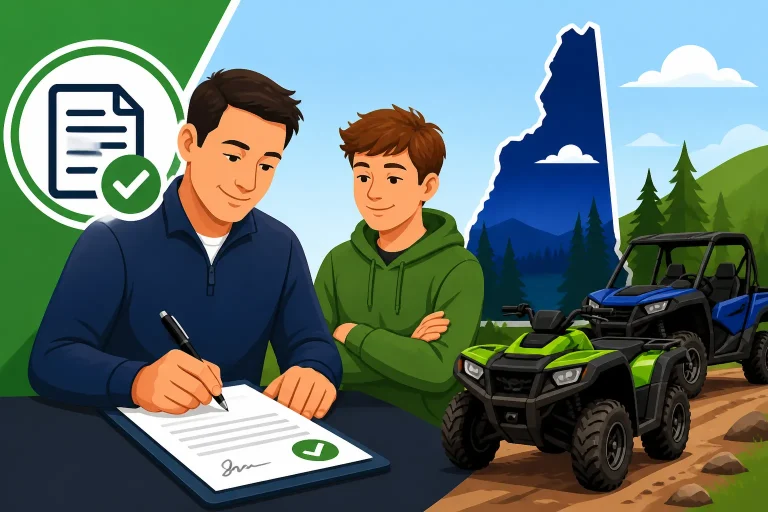
Registration requires more than arriving with the machine’s general description. According to the Town of Newmarket, NH, the owner must be at least 18 years old, apply in person, and present a valid driver’s license or non-driver photo ID. Applicants who want resident rates must present a valid New Hampshire driver’s license or New Hampshire non-driver photo ID.
The Town of Newmarket, NH, lists the vehicle details needed as the year of manufacture, make, model, displacement, primary and secondary colors, and VIN. It is worth gathering these details before you apply, so you can describe the machine accurately and avoid having to track down information midway through the process.
New Hampshire does not title OHRVs and snowmobiles, according to the Town of Newmarket, NH. The Town also says that no title, bill of sale, or previous registration is required to register. That can be reassuring if you have bought a used machine and are concerned that the seller’s paperwork is incomplete. It does not mean you should ignore other useful purchase records: keeping your own documentation can still help you maintain a clear record of the transaction.
For details about the registration process and agents, see Where to Register an OHRV in New Hampshire and New Hampshire OHRV Registration Paperwork. If you are buying a used ATV, Buying a Used ATV in New Hampshire can help you think through questions beyond the registration application itself.
A practical preparation checklist:
- Confirm the machine’s year of manufacture, make, model, displacement, colors, and VIN.
- Bring a valid driver’s license or non-driver photo ID and be ready to apply in person.
- If seeking resident rates, bring a valid New Hampshire driver’s license or New Hampshire non-driver photo ID.
- If seeking an applicable club member rate, bring appropriate proof of club membership.
- Ask NH Fish and Game about registration questions if you are unsure which registration applies.
- Check with the NH Bureau of Trails for trail openings, closures, and related trail information.
The Town of Newmarket, NH, says registration questions should be directed to NH Fish and Game. For questions about trail openings and closures, it points riders to the NH Bureau of Trails. Keeping those questions separate can save time: the registration office can address the machine’s registration, while trail information helps you decide where to ride.
A transfer means the old registration is no longer valid
A registration does not simply follow a machine from one owner to another. According to the Town of Newmarket, NH, when ownership transfers, the registration and decals on the machine are no longer valid. The new owner must register the machine in their own name.
That has a direct effect on access. If you buy a used ATV or UTV and see decals still attached, do not assume they authorize you to ride. The previous owner’s registration and decals are no longer valid after the transfer, and the new owner needs to complete registration in their own name before operating the machine off the owner’s property.
This is especially worth clarifying before a first ride after a private sale. The fact that New Hampshire does not require a title, bill of sale, or previous registration for the application does not make the seller’s old registration transferable. Those are separate points: certain documents are not required to register, but the new owner still needs a registration in their own name after a change of ownership.
For more on the process and what happens to the machine’s decals, see Selling an OHRV in New Hampshire, New Hampshire OHRV Decals and the Certificate, and Registering a Machine Bought Privately in New Hampshire. If you are purchasing a machine without its certificate, Buying a Quad With No Certificate covers that specific concern.
Before riding, use this quick check:
- Is the machine registered for the current owner?
- Is the registration still valid after any ownership change?
- Have you checked trail openings and closures?
- Do you know whether your intended route is open and accessible?
If any answer is uncertain, pause and confirm it rather than relying on decals left by a previous owner. That small check keeps registration and access from being mistaken for the same thing: registration is required, while the ride still depends on where you go and whether the route is open.
Sources
- Town of Newmarket, NH — OHRV Registration | Newmarket, NH (checked November 3, 2026)
Disclaimer
This article is for general informational purposes only and does not constitute professional advice. Laws, prices and regulations vary by location and change over time. Consult a qualified professional for guidance on your specific situation.