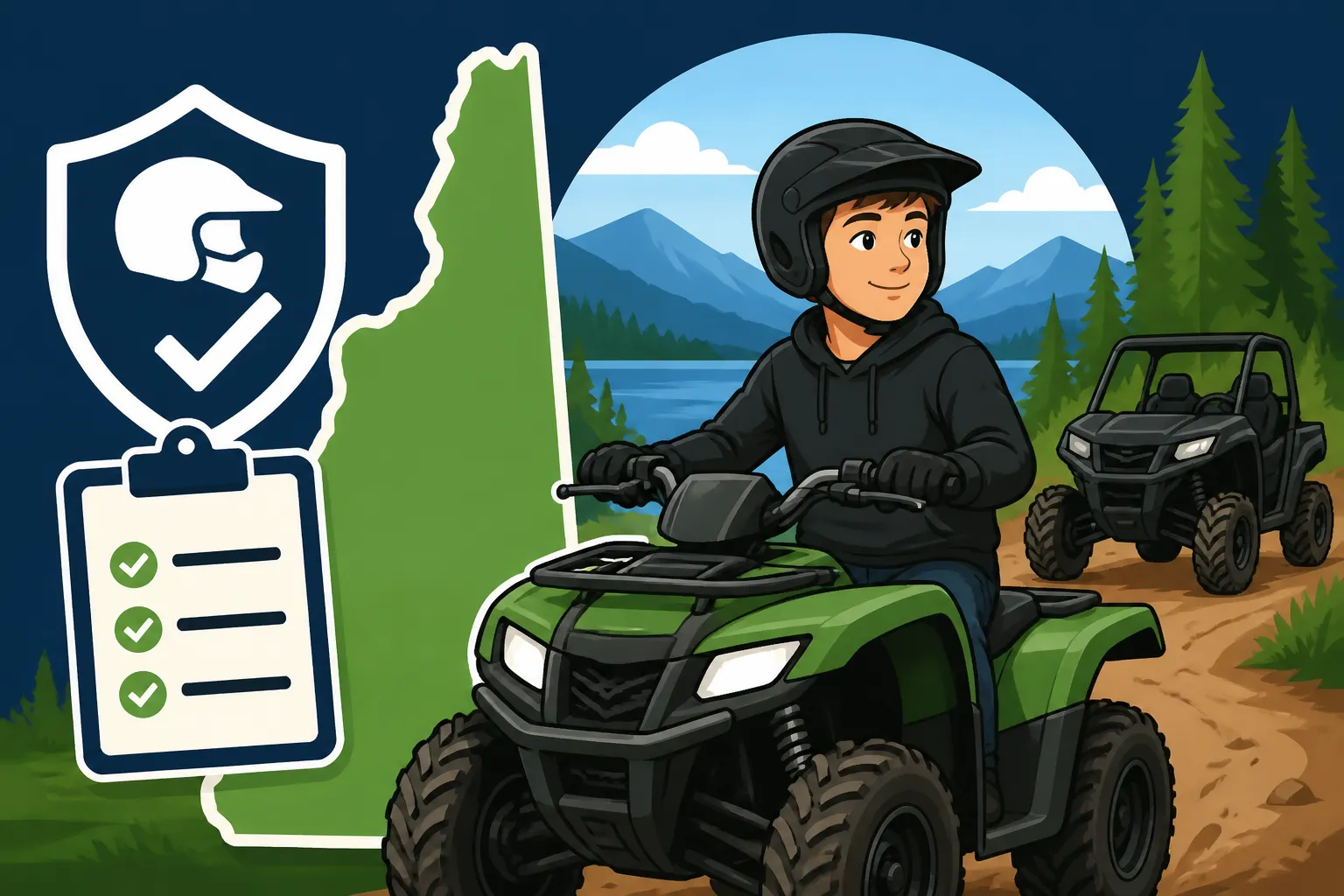
New Hampshire Rules for a Rider Aged 13
A 13-year-old can ride an ATV or UTV in New Hampshire, but a safety certificate alone does not mean they can ride without supervision. The key questions are where the machine will be ridden, who must accompany the young rider, and whether the machine and rider meet the other rules for public trails.
The basic rules for a 13-year-old rider
On New Hampshire public property, a 13-year-old must have completed an approved OHRV safety course and carry the resulting safety certificate while riding. The rider must also be accompanied by an adult who is at least 18 and holds a valid driver’s license. The adult needs to be present with the rider, not merely reachable by phone or waiting somewhere else.
These requirements apply to off-highway recreational vehicles, including ATVs and side-by-sides, when operated where New Hampshire’s public-property rules apply. A parent or other responsible adult should check the rules for the specific trail or riding area before setting out, since local access conditions and trail restrictions can add practical limits.
A safety certificate is important, but it does not replace adult supervision for a 13-year-old. It shows that the rider has completed safety education; it does not grant an exception to the age-based accompaniment rule. Similarly, adult supervision does not replace the certificate. The young rider needs to meet both requirements.
| Requirement | What it means for a 13-year-old |
|---|---|
| Safety education | Complete an approved OHRV safety course and carry the certificate |
| Adult supervision | Ride with an adult who is at least 18 and has a valid driver’s license |
| Helmet | Wear a helmet because the rider is under 18 |
| Registration | Use a properly registered machine where registration is required |
| Trail access | Confirm that the trail allows the machine’s type and width |
The certificate rule begins at age 12, so a 13-year-old should not assume that the certificate is only needed for older teens. The age requirement and course details are covered in New Hampshire’s Certificate Rule at Age 12 and [New Hampshire ATV Safety Certificate Requirements]. If the rider has not yet taken a course, check the current course options and requirements before planning a trip.
The adult’s role is more than a formality. They should be close enough to supervise the rider, help make decisions, and respond if something goes wrong. A group of young riders with no qualifying adult present does not meet the supervision requirement simply because one rider has a certificate.
Where the rules apply and what changes on private land
The supervision and certificate rules are especially important on public trails and other public property. Before riding, identify whether the route crosses public land, a club trail, a town road, or private property. A trail’s appearance does not establish that it is open to riding, and an informal path through woods is not automatically a legal route.
On private property, landowner permission matters. Do not assume that a lack of signs means riding is allowed. Ask the landowner for permission and follow any limits they set. For more on this distinction, see Riding Private Ground in New Hampshire and New Hampshire Written Permission Requirements.
A route may also cross more than one kind of land. A ride that starts on private property can enter a public trail system, and a public trail may pass over privately owned land under a permission arrangement. That is why a landowner’s permission for one area does not necessarily authorize riding the connected route. Check access for each part of the trip.
A 13-year-old and accompanying adult should also pay attention to machine restrictions. Some trails have width limits, seasonal closures, or other access conditions. A side-by-side that is too wide for a trail may be barred even when it is registered and the rider has an adult alongside. Check the club or trail manager’s current information before hauling the machine to a trailhead. [New Hampshire Rules for a Machine Over the Width Limit] explains why the machine’s dimensions can matter as much as its registration.
New Hampshire registration is another separate issue. A safety certificate does not register the ATV or UTV, and a registration does not prove that a young rider has completed safety education. When riding on public trails, confirm that the machine has the registration required for that use and that its decals and certificate are available as required. Visitors should not assume that a registration from a neighboring state is enough; see Why New Hampshire Honors No Neighbor’s Registration and [New Hampshire Rules for a Visiting Rider].
What the accompanying adult should check
Before leaving, the adult should make sure the young rider understands the route, the machine, and the rules for the place they will ride. Supervision is most useful when it is active: the adult should be able to see or otherwise closely monitor the rider, communicate clearly, and intervene when the situation calls for it.
A practical pre-ride check includes:
- Confirm the certificate. Make sure the 13-year-old has completed the required safety course and has the certificate with them. Do not rely on an adult’s certificate as a substitute.
- Confirm the adult qualifies. The accompanying adult must meet the age and driver’s-license requirements. A person who is present but does not meet those conditions is not a suitable substitute.
- Check registration and access. Verify that the machine is registered for the planned use and that the route is currently open to that type of vehicle.
- Inspect protective equipment. Riders under 18 must wear a helmet. Check that it fits correctly and is in good condition. Eye protection is also a sensible part of a ride kit; confirm the rule for the machine and riding conditions.
- Review the machine’s controls. Before moving, the adult should make sure the rider can use the throttle, brakes, kill switch, and controls safely. A certificate is not a guarantee that the rider is comfortable with a particular machine.
- Set limits for the ride. Agree on pace, stopping points, spacing, and what the rider should do if they lose sight of the adult or become separated.
A 13-year-old’s ability and the vehicle’s size should shape the plan. An ATV that feels manageable on level ground may be difficult to control on a steep, muddy, rocky, or rutted trail. A UTV’s extra weight and passenger capacity do not make it a beginner vehicle; it still requires careful control and room to stop. Choose routes and riding conditions that fit the young operator’s experience, not just the adult’s.
The adult should also set a clear rule about passengers. Carrying another young rider can change the machine’s handling and increase the consequences of a mistake. Check the manufacturer’s seating limits and the applicable New Hampshire passenger rules before carrying anyone. A machine designed for one rider should not be treated as a two-person vehicle because a short trip seems harmless.
If the trip includes a road crossing or any portion on a road, do not assume that the public-trail age rules are the only rules involved. Road use has separate restrictions and may be prohibited on a particular road. Review New Hampshire Rules for Crossing a Highway and New Hampshire Rules for Riding a Town Street before planning that part of a route.
A simple plan for a safe, legal ride
The most reliable approach is to check the requirements in order: rider, adult, machine, and route. This prevents a common mistake—confirming one requirement, such as registration, and assuming everything else is covered.
Start with the rider. At 13, the young operator should have the required safety certificate, wear a helmet, and remain accompanied by a qualifying adult on public property. The adult should keep supervision active throughout the ride rather than treating the certificate as proof that the teenager can ride independently.
Next, check the vehicle. Confirm its registration status, condition, width, and passenger capacity. Make sure the brakes, tires, lights, and controls are in working order. If buying protective equipment online, including through Amazon, check the fit and applicable safety markings rather than choosing based on appearance or a broad age label alone.
Finally, check the route close to departure. Trail access can vary by location and season, and a route shown on an old map may be closed or subject to limits. Use current information from the trail manager or club, respect signs and gates, and turn around if the route is not clearly open. New Hampshire Trail Conditions Before You Ride is useful background for checking conditions, while New Hampshire Trail Closures to Check First covers why access should be confirmed before a trip.
If the adult cannot accompany the 13-year-old, postpone the ride on public property until a qualifying adult is available. The safety certificate does not remove that requirement, and riding with another teenager does not satisfy it. When the rider turns 14, the rules may differ, so check the age-specific requirements again rather than assuming that the same conditions continue unchanged. Riders 14 and 15 Alone on New Hampshire Trails explains the next age range.
Disclaimer
This article is for general informational purposes only and does not constitute professional advice. Laws, prices and regulations vary by location and change over time. Consult a qualified professional for guidance on your specific situation.