Why a Safety Certificate Cannot Undo a Suspension
It’s a frustrating situation, to say the least. You love hitting the trails in New Hampshire, enjoying the crisp air and scenic routes, but then life throws a curveball: your driver's license gets suspended. Naturally, your mind might jump to solutions, perhaps thinking, "Well, I have my OHRV safety certificate; surely that lets me keep riding my ATV or UTV, right?" It's a common thought, but unfortunately, it's also a misconception that could lead to even more trouble. This guide is here to untangle this confusing area, explaining precisely why an OHRV safety certificate cannot undo or circumvent a driver's license suspension and what that truly means for your riding privileges here in the Granite State.
The Purpose of the New Hampshire OHRV Safety Certificate
First, let's clear up what the New Hampshire OHRV Safety Certificate actually is and what it's designed to do. This certificate is a fantastic tool for ensuring riders, particularly younger ones, have the foundational knowledge and skills to operate an Off-Highway Recreational Vehicle safely and responsibly. It’s all about education, not necessarily about a broad operating privilege like a driver's license.
What the Certificate Proves
When you earn an OHRV safety certificate, you're demonstrating that you understand the rules of the trail, safe operating procedures, and the importance of respecting the environment and other trail users. It covers crucial topics like proper gear, riding etiquette, hand signals, and what to do in an emergency. This certificate is primarily required for certain age groups, most notably for riders under 18. For instance, children under 12 have very specific [New Hampshire Rules for a Rider Under 12], and those aged 12 to 15 have their own set of requirements, often needing adult supervision and the certificate to ride on public trails.
It’s crucial to understand that this certificate focuses on the competency of operating an OHRV off-highway. It does not, in any way, grant you the privilege to operate a motor vehicle on public roads, which is the domain of a standard driver's license. The state wants to make sure you know how to handle your machine safely on the trail, which is a very different skill set and legal framework than navigating traffic on a paved road. You can learn more about what's involved in obtaining this credential through the [New Hampshire Safety Education Requirements].
When a Driver's License Can Substitute
Here's where some of the confusion can creep in. For adults aged 18 and older, a valid driver's license can often serve in place of the OHRV safety certificate when riding an OHRV on public lands or trails. This isn't because a driver's license proves OHRV-specific knowledge, but because the state recognizes that an adult who has passed a rigorous driving test and holds a valid license likely possesses a baseline level of responsibility and awareness that covers many general safety principles. In essence, for adults, the driver's license acts as a proxy for the safety certificate.
However, the key word here is "valid." If your driver's license is suspended, it is no longer considered valid in the eyes of the law. This means that its ability to substitute for an OHRV safety certificate is completely nullified. You can't use a suspended driver's license to meet any legal requirement, whether it's for driving your car or for substituting for an OHRV certificate. The system is designed to prevent individuals whose driving privileges have been revoked from finding loopholes. Understanding [Does a Driver's License Replace the Certificate in New Hampshire?] in normal circumstances is important, but its efficacy vanishes with a suspension.
Understanding Driver's License Suspensions in New Hampshire
A driver's license suspension is a serious matter, and its implications extend far beyond just being unable to drive your car to the grocery store. It represents a temporary, or sometimes permanent, removal of your privilege to operate any motor vehicle on public ways in New Hampshire.
What a Suspension Truly Means
When your driver's license is suspended, it's not just a minor inconvenience; it's a legal prohibition against operating any motor vehicle on public roads or public land that falls under the purview of motor vehicle laws. This broad definition is critical to understanding why an OHRV certificate won't help you. The state views the operation of all motor vehicles, including ATVs and UTVs when ridden on public trails, as falling under a general "privilege to operate" that is granted or revoked. Common reasons for suspension can include things like driving under the influence (DUI), accumulating too many points for traffic violations, failing to pay fines, or refusing to submit to an alcohol or drug test.
Imagine you've had your car license suspended for a DUI. That suspension is a strong signal from the state that your judgment or responsibility behind the wheel is currently compromised. The state's interest is in public safety, and that extends to any vehicle you might operate. Simply possessing an OHRV safety certificate, which demonstrates knowledge of trail rules, doesn't negate the fundamental judgment issues that led to your license suspension. The legal system isn't set up to allow you to drive one type of motor vehicle while simultaneously being deemed unfit to drive another.
The Broad Reach of a Suspension
The reach of a driver's license suspension in New Hampshire is quite extensive. It’s not a pick-and-choose situation where you can decide which type of vehicle you're prohibited from operating. If your license is suspended, it means your general privilege to operate motor vehicles has been curtailed. While OHRVs are specifically designed for off-highway use, they frequently interact with public ways—think about crossing a paved road to get from one trail section to another, or riding on a designated shoulder through a small town. In these instances, your OHRV is temporarily operating in a manner that falls under the umbrella of motor vehicle regulations.
The law considers the underlying reasons for the suspension. If you've lost your license due to reckless behavior or impairment, the state isn't going to turn a blind eye just because you're now on an ATV instead of a car. The safety certificate is for demonstrating OHRV-specific skills, but it doesn't address the broader legal and behavioral issues that lead to a license suspension. This broad interpretation is why attempting to ride an OHRV with a suspended license is fraught with legal risk, as we'll explore further.
The Legal Distinction: Driving Privileges vs. OHRV Operating Privileges
While it might seem like apples and oranges—one for roads, one for trails—the state's view of operating privileges connects them more than you might think, especially when a suspension comes into play. It's a matter of separate requirements, but interconnected permissions.
Separate, But Not Independent
Yes, the New Hampshire OHRV safety certificate and a standard driver's license have distinct requirements and serve different primary purposes. The certificate focuses on specific knowledge for safely navigating trails, understanding trail markers, and responsible off-highway operation, often crucial for younger riders who haven't yet learned to drive a car. A driver's license, on the other hand, is about the legal right to operate a motor vehicle on public roads, involving traffic laws, road signs, and interacting with other motorists.
However, these two privileges are not entirely independent, especially for adult riders. When your OHRV touches any public way, whether it's a designated road crossing, a shared-use road section, or even just pulling into a public parking lot, you are operating that OHRV in a context that involves highway laws. If your driver's license is suspended, your legal permission to operate any motor vehicle on those public ways is revoked. Therefore, even if you have an OHRV safety certificate, it doesn't magically grant you permission to operate an OHRV on public land or roads where such a privilege is needed. For adults, the driver's license is often the umbrella under which even OHRV operations on certain public areas fall.
When an OHRV Certificate Doesn't Apply
Consider a hypothetical scenario: you're an adult rider, your driver's license has been suspended for six months due to a speeding ticket accumulation, but you still possess a valid OHRV safety certificate from years ago. You decide to ride your UTV on a local club trail, which occasionally requires you to cross a Class V road or ride a short section on the shoulder of a town-designated OHRV route. In this situation, your OHRV certificate is essentially irrelevant to your ability to legally operate.
The issue isn't whether you know how to operate the UTV safely on the trail (which your certificate proves); the issue is whether you have the legal privilege to operate any motor vehicle on public land or roads. Since your driver's license, which grants that broader privilege, is suspended, you are legally prohibited from operating your UTV in any area that falls under the scope of motor vehicle laws, including those public trail sections or road crossings. Even accessories from a brand like SuperATV that enhance your machine's performance or safety won't change this legal reality. The OHRV certificate is about demonstrating competency, not about providing permission when your general operating permission has been withdrawn. It’s a very important distinction that many riders overlook.
Consequences of Riding an OHRV with a Suspended Driver's License
Ignoring the legal realities and attempting to ride an OHRV with a suspended driver's license can lead to severe repercussions, often far worse than the initial suspension. It's a risk not worth taking, as the state takes operating privileges very seriously.
What a Conservation Officer Will Look For
When you're out on the trails in New Hampshire, you might encounter a Conservation Officer from the New Hampshire Fish and Game Department. These officers are responsible for enforcing OHRV laws and ensuring rider safety. During a routine stop or check, they will typically ask for your OHRV registration, your identification, and if applicable, your OHRV safety certificate or driver's license. [What a New Hampshire Officer Checks Roadside] gives you an idea of their typical procedures.
If, upon checking your identification, the officer discovers your driver's license is suspended, that immediately becomes the primary concern. Even if you present a valid OHRV safety certificate, it will not override the fact that your general privilege to operate motor vehicles is currently revoked. The officer isn't going to say, "Oh, you have your OHRV certificate, so never mind the suspended license." Instead, they will focus on the suspended license because it represents a fundamental breach of your operating privileges. They're looking for compliance with all applicable laws, not just OHRV-specific ones.
Severe Penalties and Further Suspension
Riding any motor vehicle, including an OHRV, with a suspended driver's license is a serious offense in New Hampshire. The penalties are not minor and can include substantial fines, impoundment of your OHRV, and, most significantly, an extension of your existing driver's license suspension. What might have been a six-month suspension could easily turn into a year or more, compounded by additional fines for operating after suspension. These are not minor infractions; they are often treated with gravity because they demonstrate a disregard for the state's legal mandates.
You could be looking at hundreds or even thousands of dollars in fines, towing and storage fees for your machine, and the added stress and cost of dealing with legal proceedings. It's a stark reminder that the state intends for suspensions to be respected, and attempts to circumvent them will result in further, more severe punishment. For instance, [New Hampshire Fines for an OHRV Violation] can quickly add up, and if you're found operating with a suspended license, those fines will likely be at the higher end of the spectrum.
The Bottom Line for Riders
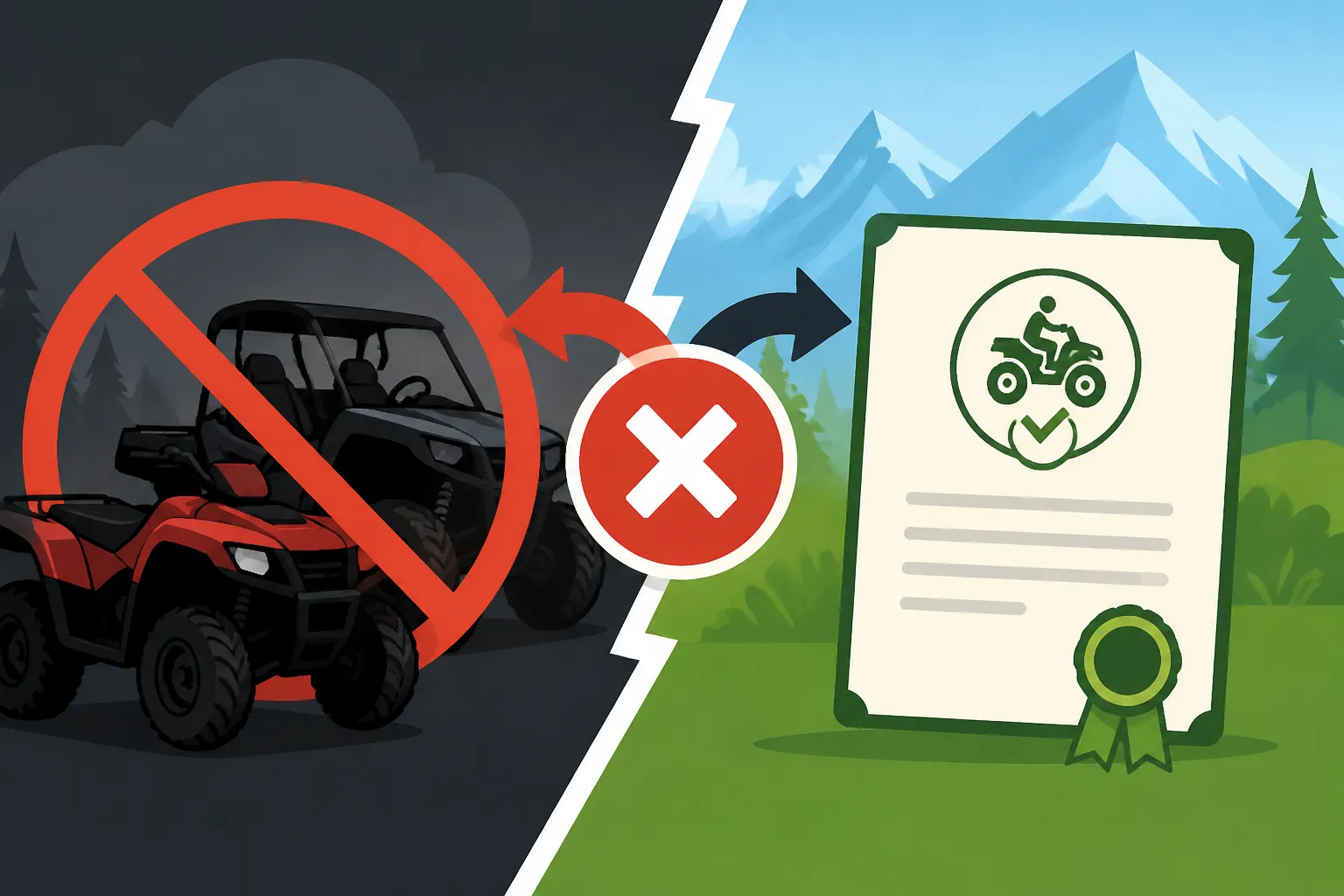
The unequivocal truth is that a New Hampshire OHRV safety certificate does not, and cannot, undo or bypass a suspended driver's license. The two credentials serve different purposes, and a suspension of your driver's license implies a broader restriction on your ability to operate motor vehicles on public land and roads. If your driver's license is suspended, the safest and only legal course of action is to refrain from operating any motor vehicle, including your ATV or UTV, on public trails, roads, or land.
It’s a tough pill to swallow, especially when you're itching to hit the trails, but it’s crucial for staying on the right side of the law and avoiding even more severe consequences. Use the downtime to maintain your machine – maybe order those new SuperATV tires you’ve been needing – or plan future rides for when your privileges are fully restored. New Hampshire prioritizes safety and adherence to its operating laws, and understanding these distinctions is key to responsible riding.
| Feature | New Hampshire Driver's License | New Hampshire OHRV Safety Certificate |
|---|---|---|
| Primary Purpose | Legal permission to operate motor vehicles on public roads | Proof of competency and knowledge for off-highway recreational vehicles |
| Administering Body | NH Department of Motor Vehicles (DMV) | NH Fish and Game Department (NHF&G) |
| Age Requirement | Minimum 16 years old for full license | Minimum 12 years old for certificate (with specific rules for younger riders, e.g., New Hampshire Age and Supervision Rules) |
| Required For | Operating cars, trucks, motorcycles on public roads | Operating OHRVs on public trails/land for specific age groups (e.g., [New Hampshire Rules for a Rider Aged 12]) |
| Can Substitute For | For adults (18+), can substitute for safety certificate on OHRV (if valid) | Does not substitute for a driver's license |
| Impact of Suspension | Prohibits operating any motor vehicle on public roads and public OHRV trails | Does not negate a driver's license suspension's impact on OHRV use |
| Effect on OHRV Use | A suspended DL generally restricts OHRV operation on public ways and trails | A valid certificate does not allow OHRV use if DL is suspended ([Riding as an Adult With No Driver's License] is generally not permitted if DL is suspended) |
Disclaimer
This article is for general informational purposes only and does not constitute professional advice. Laws, prices and regulations vary by location and change over time. Consult a qualified professional for guidance on your specific situation.