Meeting a Moose on a Coos County Trail
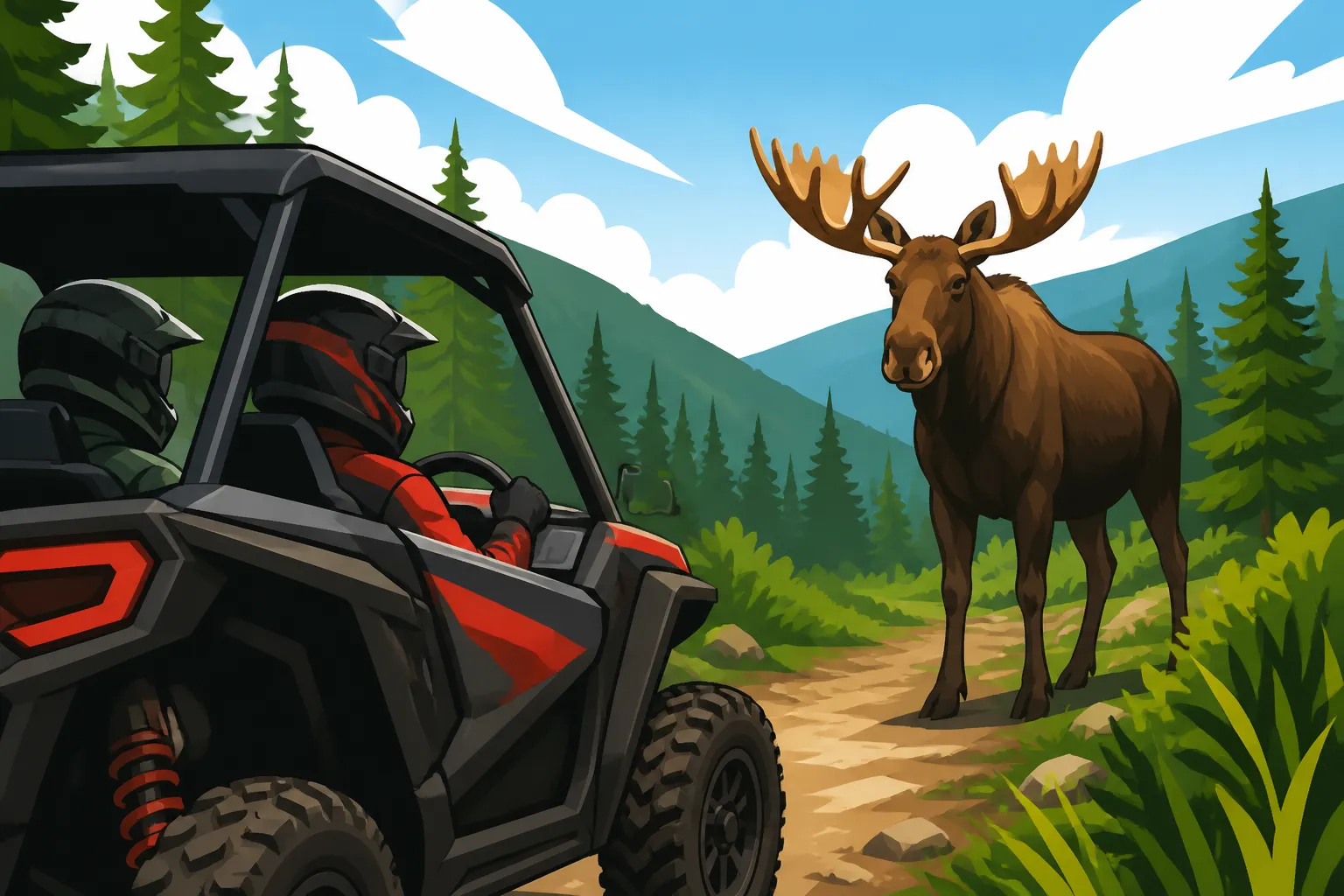
A moose stepping onto a Coos County trail can turn a relaxed ATV or UTV ride into a tense moment fast. The safest response is usually to stop, give the animal room, and avoid trying to squeeze past it. This guide explains what to do during an encounter, how to prepare before riding, and when to wait or turn around.
Why moose encounters need extra caution
A moose may react differently than you expect
Moose are large, powerful wild animals, but their size does not make their behavior easy to predict. A moose may stand still, move slowly across the trail, or suddenly change direction. It may also treat a nearby machine or rider as a threat, especially if it feels cornered or has a calf nearby.
A moose that is eating or simply crossing your route is not necessarily tame or comfortable with people. Don’t interpret a calm-looking animal as an invitation to approach. Its ears, posture, and movement can offer clues, but they are not a reliable way to decide that it is safe to ride closer.
A cow with a calf deserves particularly wide clearance. The calf may be difficult to see in brush, and the adult may become defensive if you come between them or block the calf’s route away. If you cannot tell whether a second animal is nearby, assume the moose may not be alone.
A machine can make a close encounter more stressful
An ATV or UTV is noisy, bulky, and unfamiliar to wildlife. Accelerating, revving, honking, or trying to pass at speed can startle a moose or make it feel trapped. A trail may also leave little room to move around the animal without entering the woods, soft ground, or a restricted area.
Give the moose an unobstructed way to leave. If it is on the trail, don’t ride toward it to encourage it to move. Avoid surrounding it with multiple machines, and don’t let a group spread across the trail in a way that blocks its escape route.
This matters on long rides as well as short ones. Riders planning Ride the Wilds in Coos County or Riding From Berlin to Pittsburg may pass through changing terrain and remote sections where there is no quick alternate route. Build time into your plan so you can wait rather than make a risky pass.
What to do when you see a moose on the trail
Stop, create space, and assess from a distance
As soon as you see a moose, stop well back from it. Keep other riders behind you rather than allowing them to roll forward around your machine. Don’t approach for a better look, take a close-up photo, or try to touch or feed the animal.
The right distance depends on the situation and the terrain. If the moose is close, agitated, has a calf, or is blocking the only route, increase your distance as much as the trail allows. Keep an escape route open for the animal. If it is moving away, let it continue without following.
If the moose is not moving and your position is safe, waiting is often better than attempting to get past. Be patient: it may take a while for the animal to leave the trail. If it turns toward you, approaches, or shows signs of agitation, back away slowly if you have a clear route. Don’t try to race by it or turn your back to get a closer view.
| What you see | Safer response | Avoid |
|---|---|---|
| Moose crossing the trail | Stop well back and let it cross | Accelerating to get past before it finishes |
| Moose standing on the trail | Wait at a safe distance or turn back if possible | Riding toward it or trying to push it along |
| Moose with a calf or another moose nearby | Give extra space and leave the area if you can do so safely | Passing between the animals |
| Moose approaching or acting agitated | Back away slowly toward a safe route or substantial cover | Revving the machine, shouting, or trying to outrun it |
| Trail blocked with no safe way around | Wait, then retreat if the animal does not move | Leaving the marked route to bypass it |
If the moose approaches or charges
Treat an approaching moose seriously. Don’t assume a charge is only a bluff, and don’t try to frighten the animal off with engine noise. If you can retreat safely, move away without rushing toward the moose or cutting off its path.
If a substantial barrier is nearby—such as a large tree or a solid structure—get behind it if you can do so without moving closer to the animal. Don’t rely on your ATV or UTV as a guaranteed shield. A machine may be awkward to maneuver, and trying to start or turn it while a moose is close can add noise and confusion.
If you are knocked down, curl into a protective position and cover your head and neck. Stay still until the moose has moved away, then leave the area carefully. Once you are at a safe distance, check yourself and your riding group for injuries. Contact the appropriate local authorities if anyone is hurt or if the animal presents an ongoing hazard to trail users.
Prepare for wildlife before a Coos County ride
Plan the route without assuming a map means a trail is clear
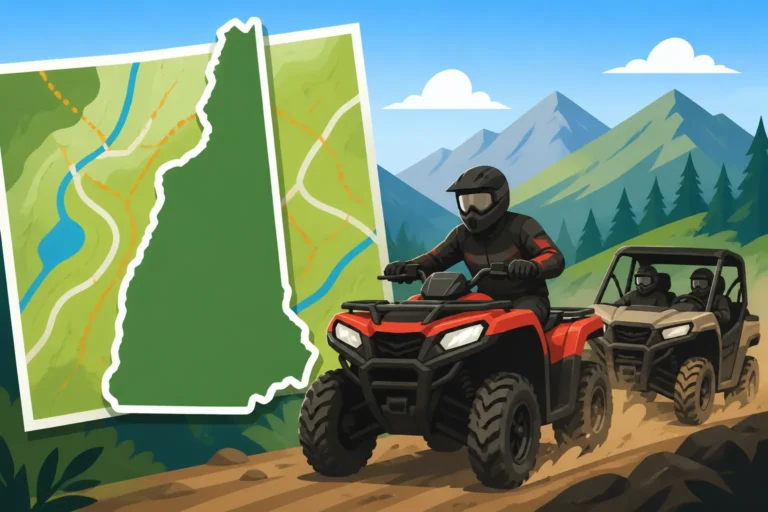
A route map can help you understand where you are and how to backtrack, but it cannot guarantee that a trail is open or that wildlife will not be present. Check current trail status before leaving, and review any posted closure or access information from the relevant club or land manager. New Hampshire Trail Status Before You Ride and New Hampshire Trail Conditions Before You Ride are useful starting points for making that check part of your routine.
Some riders use onX Offroad to plan routes and keep track of their position, particularly when riding in areas with limited cell service. Download or prepare the information you need before heading out, and don’t depend on getting a signal when you need to make a decision. A navigation app is a planning aid, not a substitute for posted signs, local trail updates, or sound judgment when an animal is in the way.
Before you start, agree on what your group will do if someone spots wildlife. The first rider should stop and alert the others without creating a rush forward. Keep enough space between machines to stop safely, and make sure everyone knows that the group will wait or turn around rather than crowd an animal.
Ride with time, space, and a way to turn back
A schedule that leaves no room for delays encourages poor decisions. Plan a route that your group can shorten if you encounter a blocked trail, changing conditions, or an animal that needs time to move away. If you are riding in a group, identify safe places to pull over and regroup without blocking the trail.
Keep noise and speed under control, particularly where visibility is limited by trees, bends, or uneven terrain. Slower riding gives you more time to notice wildlife and stop without swerving. It also reduces the temptation to make a sudden maneuver when an animal appears nearby.
Carry essentials for a longer-than-planned wait, such as water, suitable clothing, and a charged phone or other emergency communication device appropriate to your route. Tell someone where you plan to ride and when you expect to return. Riders exploring Riding Out of Errol in October should also plan for shorter daylight and changing conditions, rather than assuming they can simply make up lost time later in the day.
What not to do during a wildlife encounter
Don’t crowd, chase, or try to control the animal
A close photo is not worth putting yourself, your passengers, or the animal at risk. Don’t ride closer to improve a camera angle, follow a moose down the trail, or try to make it move by circling around it. If the animal has nowhere clear to go, your machine may be part of what is keeping it there.
Don’t split your group around the moose. Multiple machines can make an animal feel surrounded, even if every rider believes they are leaving plenty of room. Keep the group together at a safe distance, or retreat in an orderly way if a safe route is available.
Avoid leaving the marked trail to get around the animal. The ground beside a trail may be soft, steep, or environmentally sensitive, and riding off the route can create a separate safety and access problem. New Hampshire’s land-access rules matter even when a detour seems convenient; review New Hampshire Rules for Riding State Land and New Hampshire Rules for Riding Private Land before your trip.
Don’t assume wildlife is the only hazard on a shared route
A trail encounter can happen alongside other risks: limited sight lines, uneven ground, other riders, or changing trail conditions. Stay alert when entering a blind bend or narrow section, and leave enough stopping distance to respond to wildlife or another trail user.
Some routes may also be used by hunters or other outdoor visitors. Slow down, be considerate, and follow posted restrictions rather than treating a trail as an ATV-only space. Sharing a New Hampshire Trail With Hunters offers useful context for riding respectfully when other users are in the area.
If a moose has moved off the trail, don’t assume it has left the area. It may be in nearby brush and could return to the route. Wait until you have a clear view and a safe path before proceeding. If visibility is poor or the animal remains close, turning around is a sensible choice—not a failure to complete the ride.
A simple decision routine for riders
When a moose appears, use the same calm sequence every time:
- Stop well back. Signal the riders behind you and prevent the group from closing in.
- Look for other animals. Check for a calf or a second moose without approaching.
- Give the animal room. Keep its route away from you open and avoid blocking the trail’s exit.
- Wait or retreat. If the moose stays on the trail, wait at a safe distance. If the situation feels unsafe, back away or turn around when you can do so safely.
- Proceed only when the route is clear. Don’t follow the moose or ride into brush where it may be hidden.
It can feel frustrating to pause when the group is eager to reach the next staging area or finish a loop. But a wildlife encounter is exactly the kind of moment when a flexible plan pays off. A few extra minutes—or a different route—are a far better trade than startling a large animal at close range.
For navigation, onX Offroad can help you stay oriented while you wait or retrace your route, but use it alongside local trail information and posted signs. If the trail is blocked and there is no safe way forward, backtracking is the practical choice. The goal is not to get the closest view or finish the route at any cost. It is to leave the animal undisturbed and get every rider home safely.
Disclaimer
This article is for general informational purposes only and does not constitute professional advice. Laws, prices and regulations vary by location and change over time. Consult a qualified professional for guidance on your specific situation.