Pulling Over for a Log Truck
There's nothing quite like the thrill of exploring New Hampshire's vast network of OHRV trails, feeling the crisp air, and taking in the stunning scenery. However, sometimes that peaceful ride can be suddenly interrupted by the rumble of a much larger engine, the sight of a massive vehicle bearing down the trail, and the gut-wrenching realization that you need to get out of its way – fast. This guide is here to help you understand why you encounter logging trucks and other heavy vehicles on our trails, and, crucially, how to react safely and responsibly when you see one.
The Reality of Shared Roads and Trails in New Hampshire
It's easy to picture New Hampshire's OHRV trails as pristine, untouched wilderness, solely for recreational use. While many trails do offer that experience, a significant portion of our extensive network, especially in the northern reaches, operates on a complex system of shared access. These aren't always just "trails" in the conventional sense; they're often active working roads, easements, and designated town routes that serve multiple purposes, including commercial operations.
Why You'll Encounter Heavy Vehicles
Many of the most beloved OHRV trails, particularly those forming part of the expansive Ride the Wilds network, trace their origins back to old logging roads, private industrial timberland access routes, and even Class VI town roads that might look like trails but are legally still roads. Landowners, often large timber companies, generously grant permission for OHRV clubs to maintain and use these routes. However, this permission almost always comes with the understanding that commercial operations – especially logging – have the right of way.
Think about it: the very trees that make New Hampshire's forests so beautiful also fuel a vital industry. Log trucks are essential for getting timber from the woods to the mills. These trucks often traverse the same winding, sometimes narrow, paths that we enjoy on our ATVs and UTVs. You might also encounter heavy equipment for trail maintenance, utility crews working on power lines, or even other residents accessing their remote properties. It’s a multi-use landscape, and as recreational riders, we are often guests on working land. Understanding this fundamental aspect of our trail system is the first step toward safe riding. You might be riding a trail that was built and is still actively used by these very vehicles.
The Legal Obligation to Yield
Beyond common courtesy and self-preservation, New Hampshire law is clear about OHRVs yielding to larger, conventional vehicles on shared access routes. When you're operating an OHRV on a public road or a designated trail that also serves as a private access road for commercial operations, you're expected to act as the smaller, more agile vehicle. This means you must always be prepared to yield.
The principle is simple: a multi-ton logging truck, often laden with an immense amount of timber, cannot stop or maneuver like your ATV or UTV. Its blind spots are enormous, its stopping distance is long, and its ability to swerve is virtually nonexistent, especially on uneven or narrow terrain. As an OHRV rider, you have the responsibility to be aware of your surroundings, anticipate potential encounters, and take immediate action to ensure your safety and the safety of the commercial vehicle's operator. This isn't just about avoiding a ticket for a [New Hampshire Fines for an OHRV Violation]; it's about avoiding a catastrophic accident. Always remember the fundamental rule of the road, even if it's a dirt road: the smaller, more maneuverable vehicle must yield to the larger, less maneuverable one.
Understanding Log Truck Operations and Dangers
Encountering a log truck on a tight trail can be startling, but understanding their operations and the specific dangers involved can help you react calmly and effectively. These aren't just big vehicles; they represent a significant force to be reckoned with.
The Unique Challenges of Logging Trucks
Logging trucks are beasts of burden. They are incredibly heavy, often exceeding 80,000 pounds when fully loaded. Their sheer mass means they have immense momentum and require a significant distance to stop, especially on dirt, gravel, or hilly terrain. Their size also creates massive blind spots – the driver simply cannot see a small ATV or UTV in many areas around the vehicle, especially directly behind, directly in front, or along the lower sides. Adding to this, the weight of the logs can shift, and sometimes small pieces of debris can come loose.
Furthermore, logging truck drivers are professionals on a tight schedule. They're often navigating challenging terrain, focused on their job, and operating within specific timeframes. While they are usually attentive, they aren't expecting recreational vehicles to suddenly appear in their path, particularly if OHRV riders aren't following best practices for visibility and yielding. The noise of a large diesel engine can also mask the sounds of approaching OHRVs, further reducing the driver's ability to detect you. Riding a machine with a loud exhaust, even if it's a performance aftermarket part from a brand like SuperATV, can make it harder for you to hear them coming and for them to hear you.
Safety First: Anticipating and Reacting
The key to safely handling an encounter with a log truck is anticipation and swift, decisive action. Don't wait until the truck is right on top of you. Here are some critical points:
- Listen Actively: On many forest roads, you can often hear a large diesel engine long before you see the truck, especially on inclines or descents where the engine is working hard. Turn down your music, if you have any, and keep an ear out for distinct truck sounds.
- Watch for Dust: On dry days, a large plume of dust can signal an approaching heavy vehicle from a surprising distance away. Scan the horizon, especially around corners or over hill crests.
- Slow Down on Blind Corners and Hills: Always assume there's something coming around that blind bend or over the next rise. Reduce your speed significantly and stay to the far right. This gives you more time to react and allows a larger vehicle more room. This is also important for situations like [Crossing a Road on an OHRV in New Hampshire].
- Be Visible: Wear bright colors, especially blaze orange during hunting season. While you don't need a specific high-visibility decal like a [New Hampshire OHRV Decal Placement], making yourself more obvious can't hurt.
- Immediate Action: The moment you hear or see a log truck, your priority is to get out of its way. Don't hesitate. Pull over as quickly and safely as possible.
Practical Steps for Safely Pulling Over
When that log truck appears, knowing exactly what to do can make all the difference. It's not just about stopping; it's about stopping intelligently and safely.
Where and How to Stop
Your goal is to become completely invisible and unobtrusive to the passing truck.
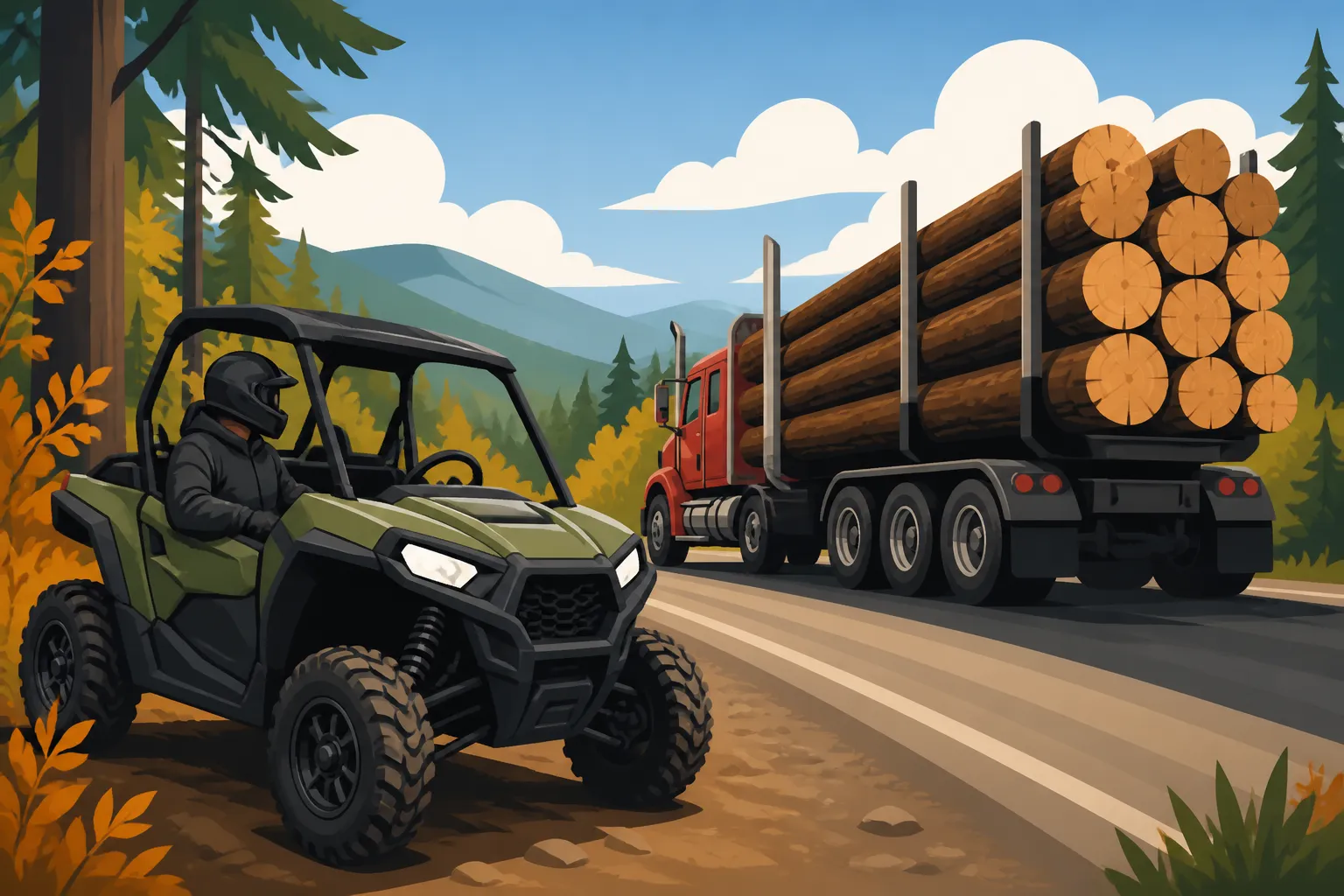
- Get Off the Travel Way Entirely: This is paramount. Don't just pull to the side; get your OHRV completely off the main travel portion of the road or trail. Look for a wide shoulder, a small pull-off, or even a very shallow ditch that you can safely navigate into. The truck needs all the room it can get, especially if it's making a wide turn or has limited visibility.
- Find a Stable and Visible Spot: Ideally, choose a spot that is relatively flat and stable, not on a steep incline or decline. Also, try to pick a location where the truck driver can clearly see you as they approach, and where you can see them. Avoid pulling over immediately after a blind corner or just over the crest of a hill.
- Turn Off Your Engine: Once you're safely pulled over, turn off your OHRV's engine. This serves multiple purposes: it reduces noise, allowing you and the truck driver to communicate if necessary (though usually, a simple wave is enough), and it signals to the driver that you are stopped and aware. It also prevents accidental throttle application if you were to lose your footing.
- Maintain a Safe Distance: If possible, give the truck ample room to pass. If you're on a narrow trail, this might mean backing up slightly to a wider spot or finding the best available safe zone. Never stop directly in the truck's path or in a position that forces it to take evasive action.
- Signal Your Presence (and Gratitude): A simple wave or a "thumbs up" to the truck driver as they pass acknowledges their presence and signals that you've seen them and are safely out of the way. This fosters good relations and shows you're a responsible rider. Many professional drivers appreciate this gesture.
Group Riding and Communication
Riding in a group adds another layer of complexity to these encounters. The same principles apply, but communication becomes even more critical.
- Alert Your Group Immediately: The lead rider is typically the first to spot or hear an approaching vehicle. Use hand signals, a helmet communication system, or even a pre-arranged verbal cue to alert everyone behind you immediately.
- Everyone Pulls Over: Emphasize that every single rider in the group must pull their machine completely off the trail. No exceptions. One rider left in the travel lane can create a dangerous bottleneck.
- Maintain Spacing: Try to pull over in a way that keeps your group relatively cohesive but still provides maximum clearance for the truck. Don't create a long line of machines along the edge of the road if there's a wider spot where you can cluster together safely.
- Designate a Leader: It can be helpful to have one person, usually the lead rider, be the point of contact or signal person for the truck driver. This avoids confusion with multiple people waving or signaling.
Equipment and Visibility Considerations
While specific equipment isn't legally mandated just for log truck encounters, certain gear can enhance your safety. Beyond wearing bright colors, consider the accessories on your machine. For instance, a durable windshield from a company like SuperATV can protect you from dust and debris kicked up by a passing truck, ensuring your vision remains clear. Enhanced lighting, while primarily for night riding, can also increase your visibility during the day, especially on overcast days or in shaded wooded areas. Think about your tires too; reliable, grippy tires are essential for quickly and safely pulling off a trail, especially if the shoulder is soft or uneven, a capability enhanced by robust aftermarket tires. Always ensure your machine is in good working order, following [New Hampshire Equipment Rules for Road Riding], so you can react swiftly and reliably.
| Action | Description | Why It's Important |
|---|---|---|
| Listen | Actively listen for engine noise, air brakes, or the sound of heavy equipment. | Early detection gives you more time to react and find a safe spot. |
| Look | Scan for dust plumes, reflections, or the truck itself, especially around blind corners and hills. | Visual confirmation helps you assess the situation and plan your pull-over. |
| Slow Down | Reduce speed significantly on blind spots and narrow sections. | More reaction time and better control of your machine. |
| Pull Over | Get your OHRV completely off the main travel path, into a safe, stable, and visible spot. | Provides maximum clearance for the truck; keeps you out of its path. |
| Turn Off Engine | Switch off your OHRV's engine once safely stopped. | Reduces noise, allows communication, signals awareness to the driver, prevents accidents. |
| Signal | Give a simple wave or "thumbs up" to the driver as they pass. | Fosters good relations and acknowledges their right of way. |
| Stay Put | Remain pulled over until the truck has passed completely and is a safe distance away. | Avoids any risk of collision from the rear or side. |
Why This Matters: Protecting Yourself and Preserving Access
Encountering a log truck isn't just an inconvenience; it's a moment that demands respect and responsible action. How we handle these situations has far-reaching implications, not only for our immediate safety but for the future of OHRV riding in New Hampshire.
Preventing Accidents and Injuries
This might seem obvious, but it bears repeating: a collision between an OHRV and a fully loaded log truck is almost certainly fatal for the OHRV rider. There is no contest in terms of size, weight, or protective capabilities. These are not minor fender-benders; they are life-altering events. By consistently practicing safe pulling-over techniques, you are taking the most fundamental step to protect yourself, your passengers, and your riding companions from catastrophic injury or death.
It's about making smart decisions on the trail, understanding the inherent risks of sharing [New Hampshire Rules for Riding a Logging Road] or [New Hampshire Rules for Riding a Class VI Road] with commercial vehicles, and prioritizing safety above all else. Your quick and correct reaction literally saves lives. Never assume the truck driver sees you; make sure you are seen, and, more importantly, make sure you are out of the way.
Maintaining Good Landowner Relations and Trail Access
Much of New Hampshire's incredible OHRV trail system exists because private landowners, often large timber companies, have graciously granted permission for OHRV clubs to use their land. This is a privilege, not a right. When OHRV riders behave irresponsibly – by failing to yield to commercial vehicles, damaging property, or showing disrespect – it jeopardizes these crucial landowner relationships. A single negative incident can lead to a landowner rescinding permission, potentially closing off miles of beloved trail for everyone.
Clubs work tirelessly to negotiate and maintain these access agreements. Your respectful behavior on shared trails reinforces the idea that OHRV riders are responsible stewards of the land and considerate users of shared resources. It's an unspoken agreement: we get to ride these fantastic trails, and in return, we respect the ongoing commercial operations that happen there. Every time you correctly [Yielding to Every Conventional Vehicle] to a log truck, you're contributing to the longevity of our trail system and helping to preserve access for future generations.
Being a Responsible New Hampshire Rider
Ultimately, safely pulling over for a log truck or other heavy vehicle is a fundamental part of being a responsible OHRV rider in New Hampshire. It reflects an understanding of the state's unique trail system, respect for other users of the land, and a commitment to safety. It's part of the broader etiquette that helps ensure the sustainability of our sport. Whether you're riding a challenging technical trail or simply enjoying a leisurely cruise on a designated [New Hampshire Rules for Riding a Town Street], you are an ambassador for the OHRV community. Your actions reflect on all of us. Let's all do our part to keep New Hampshire's trails safe and open for everyone.
Disclaimer
This article is for general informational purposes only and does not constitute professional advice. Laws, prices and regulations vary by location and change over time. Consult a qualified professional for guidance on your specific situation.