New Hampshire Rules for Crossing a Highway
There's nothing quite like the thrill of exploring New Hampshire's vast network of OHRV trails, feeling the crunch of gravel under your tires or the squish of mud beneath your treads. But then, inevitably, you encounter it: a paved road, often a busy highway, standing between you and the next stretch of adventure. It can be incredibly frustrating to have your flow interrupted, or worse, to feel uncertain about the legalities of simply getting from one side to the other. This guide is here to clear up that confusion, explaining exactly what New Hampshire requires when an OHRV needs to cross a highway, ensuring you stay safe and on the right side of the law.
The Basics of Highway Crossings in New Hampshire
Let's be real: New Hampshire is a fantastic place for OHRV enthusiasts, but it's not a free-for-all when it comes to riding on public roads. The default assumption is that OHRVs are off-road vehicles, and for good reason—they're not designed for the same speeds, handling, or visibility as conventional cars and trucks. This is why you'll often hear that [Why New Hampshire Roads Are Closed by Default]. However, the state understands that to create expansive trail networks, sometimes a crossing is absolutely necessary. It's a pragmatic approach, recognizing the need for trail connectivity while prioritizing the safety of everyone sharing the space.
When we talk about "highways" in this context, we're not just referring to major interstates where OHRVs are unequivocally forbidden. It often includes state routes, busier town roads, or any paved public way that isn't specifically designated as an OHRV-friendly street by a local municipality. The key distinction here is between crossing a road and riding on a road. The former is a permitted, albeit highly regulated, maneuver; the latter is almost universally prohibited outside of very specific, designated town roads. This distinction is crucial for every rider to understand.
Why Crossing Rules Exist
The primary reason for these strict crossing rules is, quite simply, safety. OHRVs, by their nature, are different from standard vehicles. They can be slower to accelerate, less visible to oncoming traffic, and don't always have the same signaling capabilities. When you're crossing a road where vehicles might be traveling at 55 mph or more, those differences become critical. These rules are put in place to minimize the risk of accidents for OHRV riders, their passengers, and the motorists who might not be expecting an off-highway vehicle to suddenly appear. It’s not about making things difficult for us; it’s about making sure we all get home safely.
Think of it from a legal standpoint: the state needs to balance the rights of recreational users with the general public's right to safe travel. By establishing clear, unambiguous rules for crossings, they create a legal framework that allows for trail expansion and connectivity while providing a standardized safety protocol. These rules aren't just suggestions; they are the law, designed to prevent mishaps that could lead to serious injury or even worse outcomes.
Essential Equipment for a Safe Crossing
Even for the briefest of highway crossings, certain equipment becomes absolutely non-negotiable for safety and legal compliance. You might be out on a rugged trail, covered in mud, but as soon as your tires touch that pavement to cross, you're entering a different regulatory environment.
First and foremost, a functioning rear-view mirror is paramount. You need to be able to see approaching traffic clearly without turning your head away from the path of travel. Many aftermarket companies, like SuperATV, offer excellent mirrors designed specifically for OHRVs that can withstand trail abuse but still provide clear visibility for those critical road crossings. Make sure it's securely mounted and gives you a good field of view. New Hampshire law explicitly requires a [New Hampshire Mirror Requirement for Road Riding] if you're going to be operating on any public way, even for a crossing.
Secondly, working headlights and taillights are vital for visibility, especially if lighting conditions are anything less than perfect. Even in broad daylight, flashing a headlight can make you more noticeable to an approaching driver. At dusk, dawn, or on an overcast day, they become absolutely essential. Ensure your lighting system is in good working order before you even head out on the trail, because you never know when you'll encounter a required crossing. Check out the full breakdown on [New Hampshire Lighting Requirements for OHRVs].
While adults in New Hampshire aren't always required to wear helmets on trails, it's always good practice, especially during a road crossing where the risk of interaction with other vehicles is higher. Minors, however, have stricter rules. It's a good idea to refresh your memory on [New Hampshire Helmet Law for OHRV Riders] and [New Hampshire Eye Protection Requirement] to ensure everyone in your party is properly protected, regardless of the brief nature of the crossing. After all, an ounce of prevention is worth a pound of cure, particularly when asphalt and fast-moving cars are involved.
The Specifics of a Legal Highway Crossing
Now, let's get into the nitty-gritty of how you legally and safely cross a highway in New Hampshire. These aren't just recommendations; they are explicitly defined legal requirements. Failing to follow them can result in fines, accidents, and a black mark against the OHRV community as a whole. It’s all about minimizing your presence on the paved surface and maximizing your visibility and safety.
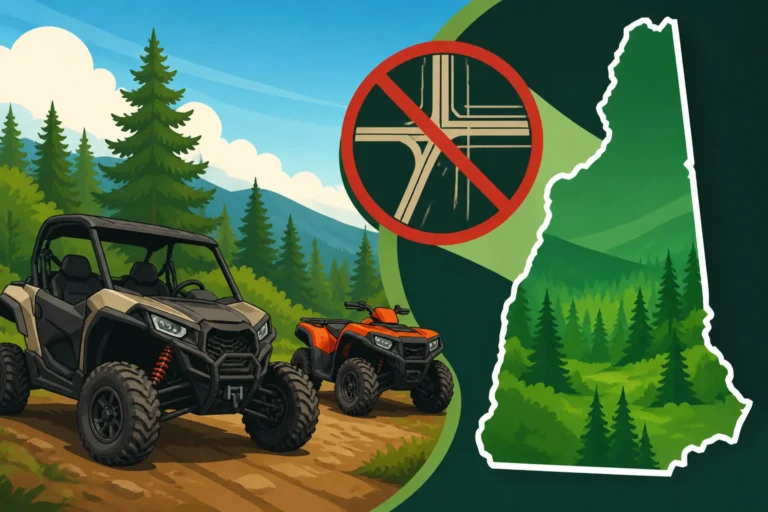
The cornerstone of New Hampshire's crossing rules is the "90-degree rule," or more accurately, crossing "as nearly as practicable at a right angle" to the highway. This means you approach the road, stop, check for traffic, and then proceed directly across to the other side, aiming for a straight, perpendicular path. The idea is to spend the absolute minimum amount of time on the paved surface. This isn't the time for parallel cruising or any kind of sightseeing; it's a direct point A to point B maneuver. You can learn more about this in detail by checking out [Crossing at Ninety Degrees in New Hampshire].
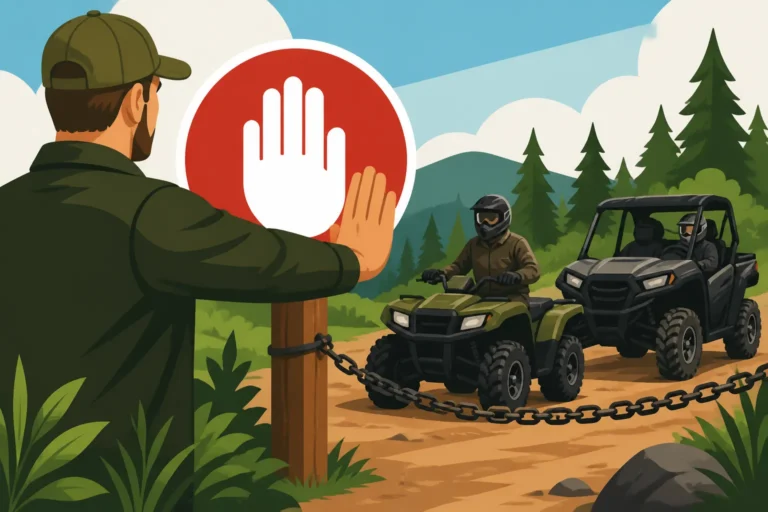
Equally important is the absolute requirement to come to a full and complete stop before you even begin your crossing. This isn't a "slow roll" or a "yield sign" situation. You must bring your OHRV to a dead stop at the edge of the pavement, or at a designated stop line if one is present. This gives you the crucial moment to perform a thorough check for traffic in both directions, allowing you to assess the speed and proximity of oncoming vehicles. We've got a whole post on [Why You Must Stop Before Every Road Crossing] that dives deeper into this critical safety step.
Once you've stopped and determined it's safe to proceed, remember that you must always yield to all conventional vehicles. They have the right of way. This means if there's any doubt, you wait. Don't pull out in front of someone or try to beat traffic. Your OHRV, even if it's a powerful UTV from a brand like SuperATV, is not built for sudden acceleration into traffic like a car. Patience is your best friend here. This rule is fundamental and is explored further in [Yielding to Every Conventional Vehicle].
The 90-Degree Rule in Practice
Visualizing the 90-degree rule is essential for practicing it safely. Imagine you're approaching a paved road from a trail. Your goal is to line up your machine so that when you cross, you're moving directly across the lanes of traffic, not at an angle that takes you down the road. If the trail exits at a slight angle to the road, you'll need to adjust your approach to make that crossing as perpendicular as possible.
This minimizes the time your vehicle is exposed to fast-moving traffic. It also makes your intentions clearer to other drivers. A vehicle moving directly across a road is easier for motorists to predict and react to than one that's angling down the shoulder or trying to blend into traffic. It's a moment of precision and focus. You'll want to choose a crossing point that offers the best visibility and the most direct route across. Sometimes the trail itself will lead you to an ideal spot, but sometimes you might need to maneuver a bit at the edge of the trail.
Stop, Look, and Listen
This isn't just an old railway crossing adage; it's a life-saving protocol for OHRV highway crossings. A "full, complete stop" means your wheels are no longer turning, and you have physically paused your forward momentum. From this stopped position, you perform a thorough scan. Look left, look right, and if it's an intersection, check for cross-traffic. Don't rely solely on your peripheral vision. Actively turn your head to ensure no vehicles are rapidly approaching.
Waiting for a safe gap is perhaps the most crucial part. What constitutes a "safe gap" depends on many factors: the width of the road, the speed limit, the actual speed of approaching vehicles, and your machine's acceleration capabilities. If you're unsure, or if you feel you'd have to rush, then don't go. It's far better to wait for several vehicles to pass than to force a crossing. Remember, other drivers might not anticipate an OHRV crossing, and giving them ample time to react if they do see you is paramount. Always prioritize safety over saving a few seconds. For a deeper dive into making sure you have a clear view, read up on [Sight Lines at a New Hampshire Crossing].
What to Avoid and Common Misconceptions
It’s just as important to understand what not to do as it is to know what is permitted. The rules for highway crossings are strict because they address high-risk situations. Deviating from them can have serious consequences, not just for you, but for the entire OHRV community and our continued access to trails.
The absolute golden rule is: never ride along the highway. Your OHRV is allowed to cross the pavement, not travel down it, not even for a hundred feet. This is where many riders get into trouble, often out of convenience or a misjudgment of distance. The moment you start paralleling the road, even if it's just to get a better angle for a subsequent crossing, you are likely breaking the law and putting yourself in extreme danger. This also means no U-turns on the highway pavement, no driving on the shoulder for extended periods, and certainly no treating a state route like a connector trail.
It’s also crucial to distinguish between a major highway crossing and designated "open roads" within specific towns. Some towns in New Hampshire have actively voted to open certain public streets to OHRV traffic, allowing riders to travel on those roads for specific purposes, often to connect different trail sections or access businesses. This is a very different scenario from simply crossing a state highway. If you're on a designated open road, you'll usually see specific signage indicating it. These are exceptions, not the rule. To understand which towns offer this, check out [New Hampshire Towns That Allow OHRVs on Roads]. Don't assume a highway is an open road just because it's in a town that has some open roads.
The Dangers of Unauthorized Highway Use
The dangers of unauthorized highway use by OHRVs are stark. The most immediate and obvious risk is a severe accident. OHRVs are not built to withstand collisions with full-sized vehicles, and the speed differential on a highway can be immense. Such an accident could lead to catastrophic injury or fatality for the OHRV operator and passengers, and potentially for occupants of the other vehicle. Beyond the physical risks, there are severe legal ramifications.
Riding illegally on a highway will almost certainly result in significant fines. These aren't just minor tickets; they can be substantial, and they often come with additional penalties, like having your machine impounded. That means a ruined ride, the hassle of retrieving your OHRV, and a hefty bill to get it back. You can find out more about the financial consequences in [New Hampshire Fines for an OHRV Violation]. Beyond personal consequences, every time an OHRV operator is caught riding illegally on a highway, it creates negative publicity for the sport. It reinforces stereotypes about reckless riders and can make it harder for clubs and advocacy groups to secure and maintain trail access. We all have a responsibility to ride responsibly and legally to protect our sport.
Misconceptions About Road Access
There are a few common misconceptions that can lead riders astray when it comes to road and highway access:
- "It's just a short stretch, no one will notice." This is perhaps the most dangerous thought process. Law enforcement officers actively patrol roads, and even if they don't see you, another motorist might report you. The length of your illegal ride doesn't make it any less illegal or any less dangerous. A short stretch at 55 mph can become a disaster in seconds.
- "My OHRV is registered, so I can ride on the road." While registration is absolutely mandatory for riding on any public OHRV trail, it does not grant you permission to ride on public roads or highways. Registration is for legal trail access, not street legality. The rules about [When New Hampshire Registration Applies] are about where you can ride the machine, not about turning it into a street-legal vehicle.
- "Other people do it, so it must be okay." Unfortunately, you will sometimes see other riders making illegal maneuvers. This does not make it acceptable or legal for you to do the same. Following someone else's bad example is a quick way to get yourself into trouble. Always rely on the official rules and your own judgment, not the actions of others.
- "I've added turn signals and mirrors, so it's street legal." While equipment like good mirrors, often available from brands like SuperATV, and proper lighting are essential for safe crossings and can improve visibility, simply adding these accessories does not magically make your OHRV street legal in New Hampshire. The state has very specific criteria for street legality, and simply bolting on a few accessories is rarely enough to meet them.
Planning Your Route for Highway Crossings
Good planning is the unsung hero of a great OHRV ride, especially when it involves navigating roads. You don't want to be caught off guard by a major highway that has no legal crossing, forcing you to backtrack or, worse, attempt an illegal maneuver. Thinking ahead is key to a smooth, enjoyable, and lawful experience.
Utilizing up-to-date trail maps is your first and best defense. These maps, often provided by local clubs or the state Bureau of Trails, will clearly show designated OHRV trails and, crucially, where those trails intersect or cross public roads. Many will even indicate specific legal crossing points. Don't rely on memory or old maps; trail systems and road designations can change. Always check the latest information before you trailer up and head out.
Understanding bridge rules is another important aspect. Not all bridges are open to OHRVs, even if they connect two parts of a legal trail. Some bridges might be too narrow, structurally unsound for OHRV weight, or simply not designated for OHRV use. The maps should indicate which bridges are permissible for crossing. [Which Bridges a Machine May Legally Cross] will give you a detailed look into this. Sometimes, what looks like a natural, easy connection over a river might actually be a prohibited crossing, forcing you to find an alternative.
Whenever possible, seek alternative routes that allow you to avoid major highways altogether. Sometimes a slightly longer, more circuitous route on a designated trail system is far preferable to a quick but dangerous highway crossing. The role of OHRV clubs in New Hampshire is absolutely vital here. These volunteer organizations work tirelessly with landowners and municipalities to establish and maintain legal trail systems, including safe crossing points. They often create bypasses or work to get less-trafficked roads officially designated for OHRV travel, making your ride safer and more enjoyable. Supporting these clubs through membership helps them continue this crucial work, expanding the [New Hampshire's Club Trail Network].
Pre-Ride Planning and Map Reconnaissance
Before you even load your machine onto the trailer, sit down with a current trail map. Look at your intended route, especially focusing on areas where the trail interacts with public roads.
- Identify designated crossings: These are typically marked on maps. They might be specific intersections, paved sections clearly signed for OHRV use, or even overpasses/underpasses.
- Note "no OHRV" areas: Just as important are the sections where OHRVs are explicitly prohibited, or where no legal crossing exists. Knowing these ahead of time prevents last-minute dilemmas on the trail.
- Check for closures: Sometimes, a section of trail or a crossing might be temporarily closed due to logging, maintenance, or environmental reasons. Always check the latest trail conditions from the club or state before you go.
Good planning ensures you're never caught unaware at the edge of a busy highway with no safe or legal way to continue your ride. It allows you to anticipate challenges and choose the safest, most enjoyable route.
Connecting Trails Safely
The beauty of New Hampshire's OHRV network is its vast connectivity, allowing for multi-day adventures and rides that link towns. This connectivity often relies on strategically placed road crossings. The success of these connections is largely due to the hard work of local clubs, who collaborate with private landowners, the state, and municipalities. They negotiate permissions, mark trails, and advocate for safe crossing designations.
When you're riding through northern New Hampshire, especially in areas like the Ride the Wilds network, you'll encounter many points where trails temporarily use town roads or cross state routes. These are usually well-marked and have been officially approved. Respecting the signage, adhering to speed limits on town roads, and executing highway crossings perfectly are all ways to ensure these privileges continue. For riders with wider machines, it's particularly important to remember that while your [New Hampshire Rules for a Machine Over 50 Inches] might limit you on certain trails, the rules for crossing a highway apply universally to all OHRV types. The pavement is unforgiving for everyone.
It's truly a cooperative effort. Riders follow the rules, clubs maintain the trails and relationships, and the state provides the framework. This ensures that the adventure of connecting diverse trails and exploring New Hampshire's stunning scenery can continue for years to come.
Highway Crossing Dos and Don'ts
To summarize the critical points for safely and legally crossing a highway with your OHRV in New Hampshire, here's a quick reference table:
| DO | DON'T |
|---|---|
| Come to a complete stop at the pavement edge. | Roll slowly or assume the right-of-way. |
| Look left, right, and listen for traffic. | Cross without a clear view or safe gap. |
| Yield to all conventional vehicles. | Expect other vehicles to stop for you. |
| Cross as nearly as practicable at a 90-degree angle. | Ride along the highway, even briefly. |
| Cross at the shortest, most direct point. | Make U-turns or extended maneuvers on pavement. |
| Ensure your OHRV has functioning lights and a rear-view mirror. | Rely on hand signals alone for visibility. |
| Check current trail maps for designated crossings. | Assume any road intersection is a legal crossing point. |
| Be patient and wait for a safe opportunity. | Rush or take unnecessary risks. |
| Support OHRV clubs that create and maintain trail connections. | Ride off-trail to avoid a legal crossing. |
Disclaimer
This article is for general informational purposes only and does not constitute professional advice. Laws, prices and regulations vary by location and change over time. Consult a qualified professional for guidance on your specific situation.