New Hampshire Safety Certificate Minimum Age
New Hampshire’s ATV safety certificate has a minimum age, but reaching that age does not automatically mean a young rider can use every trail or ride without supervision. The key is to separate course eligibility from operating rules. Here’s how the age requirement works, what else affects a minor’s ride, and what to confirm before heading out.
The minimum age for a New Hampshire safety certificate
In New Hampshire, a rider must be at least 12 years old to earn an OHRV safety certificate. The certificate shows that the rider has completed approved safety education. It is not a registration, a driver’s license, or permission to ride wherever and however they choose.
That distinction matters because several rules can apply to the same young rider. A certificate may satisfy the safety-education requirement, while the rider’s age, license status, machine type, location, and supervision still affect whether the ride is allowed. The certificate is one part of the picture, not a general authorization.
For a child younger than 12, the minimum age rule means the child cannot yet earn the certificate. Do not assume that a parent’s certificate, a course enrollment, or a promise to complete training later can stand in for the child’s own certificate when one is required. Before a younger child operates a machine, check the current rules for the specific property and riding situation. Rules for private land can differ from rules for public property and designated trails.
At age 12, a rider becomes eligible to take the course and earn the certificate. That does not mean every 12-year-old may ride alone. New Hampshire has additional age and supervision rules, and those rules can depend on where the machine is being operated. The practical takeaway is to verify both the certificate requirement and the rider’s supervision requirements before leaving home.
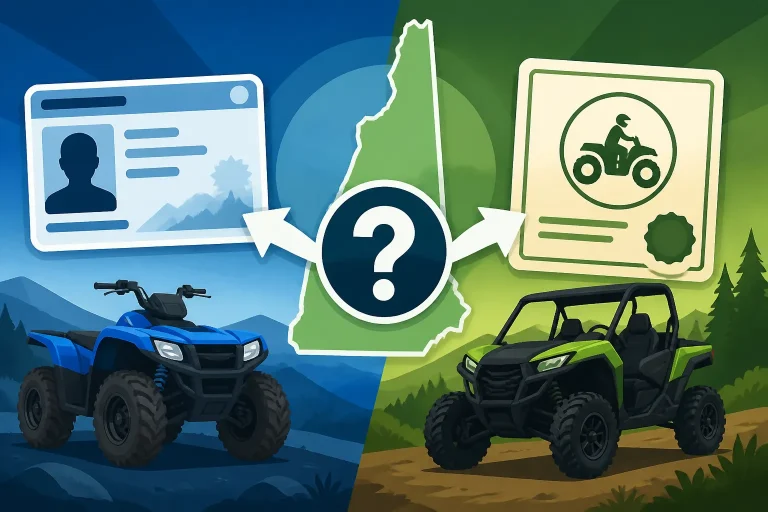
The state’s certificate rule is also not the same thing as a universal rule that every operator must take the course. A valid driver’s license may satisfy the safety-education requirement in situations where a certificate would otherwise be needed. Whether that exception applies to a particular rider is worth checking before the trip; a learner’s permit or another document should not be treated as a valid driver’s license without confirmation.
For a closer look at the age threshold itself, see New Hampshire’s Certificate Rule at Age 12. If you are sorting out which rules apply to a child at different ages, New Hampshire Rules for Riders Under 18 provides useful context.
What changes when a rider turns 12
Turning 12 changes one important thing: the rider can now complete the approved safety course and earn a certificate. It does not automatically remove other limits. A young operator may still need an adult companion, may face restrictions tied to a particular age bracket, and must follow rules for the land or trail being used.
| Rider’s situation | What the age threshold means | What to check before riding |
|---|---|---|
| Younger than 12 | Not yet old enough to earn the OHRV safety certificate | Whether the location and circumstances allow the child to operate a machine, and what supervision is required |
| Age 12 or older without a valid driver’s license | Eligible to earn a certificate; a certificate may be required for operating | Whether the certificate is complete and whether age-specific supervision rules apply |
| Age 12 or older with a valid driver’s license | The license may satisfy the safety-education requirement | Whether the license qualifies and whether other age or location rules still apply |
| Any minor on a public trail or property | The certificate does not by itself determine whether the ride is permitted | Applicable age, supervision, helmet, machine, registration, and trail rules |
The table is a planning aid, not a substitute for checking the current rule that applies to the exact ride. In particular, do not interpret “eligible at 12” as “free to ride without an adult at 12.” The age and supervision requirements have their own details. The rules for Riders 12 and 13 on New Hampshire Public Property and Riders 14 and 15 Alone on New Hampshire Trails can help clarify how those age brackets differ.
A certificate also does not make an unregistered machine legal for use where registration is required. Nor does it open a closed trail, authorize riding on land without permission, or permit a machine that does not meet a trail’s restrictions. For visitors, another state’s registration does not necessarily meet New Hampshire’s requirements; see Riding New Hampshire With an Out-of-State Machine before bringing a machine across the border.
How to get the certificate and prepare a young rider
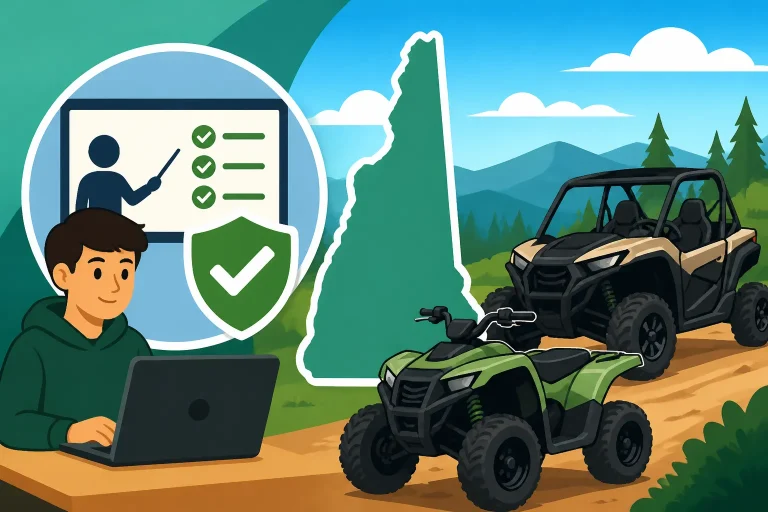
A young rider who is at least 12 can take an approved New Hampshire OHRV safety course. Course options and enrollment instructions can change, so confirm the current process with the official state source before signing up. Some families may prefer a classroom course, while others may look for an approved online option. The right choice depends on availability, the child’s learning style, and the course’s current requirements.
Use this simple sequence to prepare:
- Confirm the rider’s age and status. Make sure the child has reached the minimum age to earn the certificate. If the rider has a driver’s license, verify whether it satisfies the safety-education requirement in the intended riding situation.
- Choose an approved course. Check that the course is recognized for New Hampshire OHRV safety education. Do not rely on a general ATV video or an unrelated course to meet a state requirement.
- Complete the course and keep proof. Follow the course provider’s instructions for receiving and retaining the certificate or proof of completion. Confirm what the rider must carry or be able to show while riding.
- Check the rules for the route. Look at age and supervision requirements, registration, trail opening status, machine-width limits, and any local restrictions. A course certificate does not override these rules.
- Review the machine and riding plan with the child. Talk through stopping, turns, hills, trail signs, other riders, and what to do if the group becomes separated. Keep the first ride within the young operator’s skills and the machine’s capabilities.
Training can be useful even when a rider’s driver’s license may meet the education requirement. The course teaches OHRV-specific safety practices and gives families a structured opportunity to discuss trail conduct. But a certificate is only evidence of completed education; it is not proof that a rider is ready for a powerful or oversized machine.
Choose a machine that the rider can control comfortably. A young person should be able to reach the controls, operate them reliably, and handle the machine’s weight and power. A certificate does not make an unsuitable machine safe. Adult supervision should also be active: the accompanying adult needs to be able to monitor the rider and respond if the situation changes.
Paperwork deserves a quick check before the ride. Confirm that the machine has the registration required for the planned use, and that the appropriate certificate or license evidence is available. New Hampshire’s registration and safety education are separate subjects; New Hampshire Safety Education Requirements explains the education side, while Registering an OHRV in New Hampshire covers registration.
Rules to check beyond the certificate
Families often focus on the course because it has a clear age threshold. Yet the most important question on ride day may be whether the young person can operate in that particular place under the intended supervision.
Age and supervision
New Hampshire has separate rules for minors, and they do not all begin or end at the certificate age. A young rider’s age can affect whether an adult must accompany them and what kinds of riding are allowed. Check the rule for the rider’s precise age rather than applying a general “under 18” assumption to every situation.
The companion’s role may also matter. If a rule requires an adult or licensed rider, make sure the person accompanying the child meets the definition that applies. Having an adult somewhere on the same trail system may not be enough if the rule calls for closer supervision. New Hampshire Supervision Rules for Minors and Why an Unlicensed Rider Needs a Companion at Any Age address situations where supervision and licensing are relevant.
Public trails, private land, and road use
A certificate does not create access rights. On private land, permission from the landowner is a separate issue. On public land or a club trail, access can depend on the property’s rules, trail status, registration, and machine restrictions. A route that is open to one class of machine may not be open to another.
Road use is another separate matter. New Hampshire does not make every ATV or UTV street-legal simply because its operator has a certificate. A town may designate specific roads for OHRV use, and road riding or crossing can have additional requirements. For young riders, check both the location’s access rules and the age-specific operating rules before including a road segment in the route.
Helmet and protective equipment
Young riders should be prepared for applicable helmet and eye-protection rules, as well as the practical need for protective gear. The safety certificate does not replace equipment requirements. A helmet that fits correctly, suitable eye protection, gloves, sturdy clothing, and boots can help reduce exposure to common riding hazards, though no equipment makes risky riding safe.
Check the current requirements for the rider’s age and the machine being used. A passenger may be subject to separate requirements, and not every machine is designed to carry one. Before taking a child as a passenger or allowing them to carry someone else, confirm that the machine is designed for passengers and that the relevant rules allow it.
Registration and trail conditions
New Hampshire registration is a separate requirement from safety education. A certificate does not serve as a registration decal or certificate, and registration does not substitute for a safety certificate when one is required. For visitors, do not assume a home-state registration automatically covers riding in New Hampshire. Review Why New Hampshire Honors No Neighbor’s Registration and the state’s current visitor requirements.
Finally, check that the trail is actually open. Seasonal closures, temporary conditions, landowner decisions, and club notices can affect access. Young riders may be less prepared to deal with mud, deep water, steep terrain, or sudden changes in trail conditions, so choose a route that fits their experience and the machine. Confirm current trail information and have a simple plan for turning back if conditions are beyond the group’s comfort level.
The safest approach is to treat the certificate as the starting point: verify the rider’s age, complete approved education when required, confirm supervision and access rules, and match the route and machine to the rider’s abilities. If any part of the requirement is unclear, check with New Hampshire Fish and Game or the relevant property or trail manager before riding.
Disclaimer
This article is for general informational purposes only and does not constitute professional advice. Laws, prices and regulations vary by location and change over time. Consult a qualified professional for guidance on your specific situation.