Do You Need a Trail Pass in New Hampshire?
If you are planning an ATV or UTV ride in New Hampshire, it is easy to assume you need a separate trail pass on top of registration. Generally, you do not: New Hampshire uses OHRV registration as the main requirement for riding, while access still depends on where you go and whether that land is open to your machine.
New Hampshire does not have a separate statewide trail pass
For ordinary ATV and UTV trail riding, New Hampshire does not sell one statewide trail pass that you add to your registration. Instead, a valid New Hampshire OHRV registration is generally the key document you need for riding on trails open to OHRVs. That is why the short answer to “Do I need a trail pass?” is usually no—but it is not the same as saying registration lets you ride anywhere.
Registration and permission are separate questions:
- Registration identifies the machine as registered for OHRV use under New Hampshire’s system.
- Access depends on the landowner, trail designation, seasonal status, machine restrictions and any site-specific charge.
A sticker or certificate is not an all-access ticket. A trail may be closed, restricted to a particular machine width, or open only during certain seasons. Private land may require permission, and a facility or park may charge for use even when your machine is registered.
The basic distinction is covered in New Hampshire ATV Permits Explained. For the reason New Hampshire does not sell a separate statewide sticker, see [Why New Hampshire Sells No Separate Trail Sticker]. In practical terms, registration is the main state-level requirement; it does not replace checking the rules for a particular trail or riding area.
| What you are checking | Is a separate trail pass usually needed? | What to confirm |
|---|---|---|
| Ordinary New Hampshire OHRV trails | No statewide pass is generally added to registration | Valid registration, trail opening status and machine restrictions |
| A specific park or managed riding area | Possibly a separate site fee | Day-use or facility rules for that location |
| Private land | A pass is not a substitute for permission | Whether the owner has authorized riding |
| A trail crossing or connecting route | Usually no separate statewide pass | Whether that exact route is open and legal for OHRVs |
| A machine registered in another state | A home-state registration may not satisfy New Hampshire requirements | New Hampshire registration or an applicable visitor option |
The phrase “trail pass” can also mean different things to different riders. Someone may be asking about an additional state sticker, a club membership, a day-use charge, or permission to ride a particular trail. Those are not interchangeable. Before paying for anything, identify which requirement applies to your destination.
What registration covers—and what it does not
A New Hampshire OHRV registration is the state registration for an eligible off-highway recreational vehicle, such as an ATV or UTV. The registration process provides the required registration documents and decals. Carry and display them as required, and make sure the information matches the machine you are riding.
Registration does not give you permission to use every trail or piece of land. It does not override a closed sign, a landowner’s restriction, a width limit or seasonal closures. Nor does it automatically cover special charges set by a specific recreation area. Think of registration as a condition for riding where OHRV use is allowed—not as a promise that every route is open.
That distinction matters especially when a route crosses different kinds of property. A trail system may include private land made available through agreements, public land with its own restrictions, or roads that are subject to separate rules. A route shown on a map is not necessarily open every day or to every machine. Follow posted signs and current trail information rather than assuming the registration sticker settles the question.
For land that is not part of an open, designated riding route, the safe approach is to get permission before entering. New Hampshire Rules for Riding Private Land explains why registration alone does not authorize travel across private ground. If a trail crosses land used under an agreement, access can depend on the conditions set by the owner or manager.
New Hampshire also has location-specific charges. Jericho Mountain State Park, for example, may have day-use requirements separate from your OHRV registration. Check the current rules for the particular facility before you arrive; do not assume that registration includes admission. The details are covered in Jericho Mountain Day Use Fee.
A club membership is another item riders sometimes mistake for a trail pass. Membership may support a club and can qualify a registrant for a discounted registration rate when the applicable requirements are met. But membership is not a substitute for registering the machine, and it does not make a closed or restricted trail available. See New Hampshire’s Club Membership and Access for how membership and trail access relate.
Visitors and out-of-state machines
If you are visiting from another state or Canada, do not assume that the registration on your machine automatically gives you permission to ride New Hampshire trails. New Hampshire has its own OHRV registration requirements, and an out-of-state registration may not be enough for riding here. The rule can catch visitors who have registered their machine at home and expect that paperwork to work everywhere.
Before traveling, check whether you need a New Hampshire registration for your machine or whether a limited-duration option applies to your visit. New Hampshire offers a ten-day registration option for eligible visiting wheeled vehicles, but details and availability should be confirmed through an official registration source. The New Hampshire Ten-Day Registration Cost page addresses that option; check the current requirements rather than relying on an old receipt or a secondhand summary.
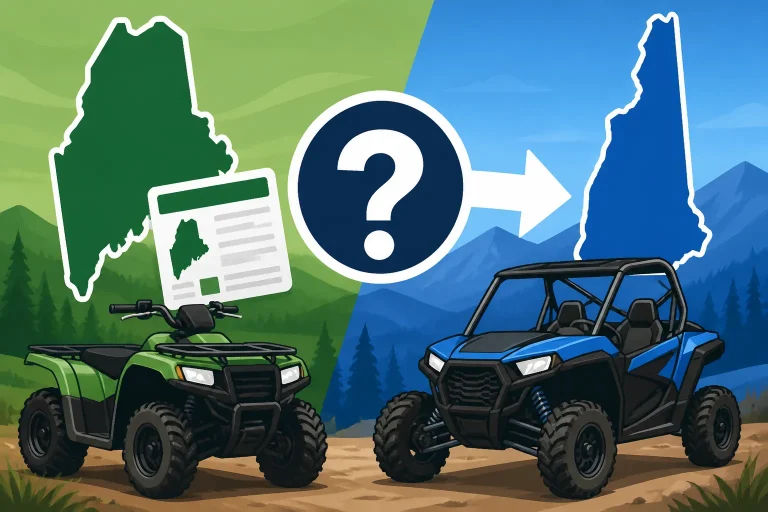
This matters even if you only plan to ride for a day or two. The length of your trip does not, by itself, make an out-of-state registration valid for New Hampshire. For visitors coming from Maine, the key issue is whether the home registration is recognized for use here; see Does New Hampshire Honor a Maine Registration?. Riders from other states should check the corresponding New Hampshire requirements for their home state and machine.
A practical pre-trip check is:
- Identify the machine. Confirm whether it is an ATV, UTV or another type of OHRV, and note its width if the route has machine limits.
- Check its registration status. Find out whether a New Hampshire registration is needed or whether the visitor option applies.
- Confirm where you plan to ride. Verify that the actual trail or riding area allows your type and size of machine.
- Check for separate site charges. A state registration does not necessarily cover admission or day use at a specific facility.
- Check current trail conditions. Open dates, temporary closures and access conditions can change.
For a broader explanation of registration and visitors, see Riding New Hampshire With an Out-of-State Machine. If you are still unsure which registration applies, use an authorized registration agent or contact the appropriate state office before you trailer the machine north.
How to avoid paying for the wrong thing
A little checking before a ride can prevent two common mistakes: paying for something that is not required, or arriving with registration but no legal access to the place you want to ride.
Start with the destination, not the phrase “trail pass.” If you are riding an ordinary open OHRV trail, ask whether your machine needs a valid New Hampshire registration. If the destination is a named park or managed site, check its admission and day-use rules separately. If a route crosses private property, confirm that the route is authorized and currently open. These are different questions, and one payment will not necessarily answer all of them.
Use current information when checking trail access. A trail may be open in one part of the season and closed in another. Mud-season restrictions, maintenance work, landowner decisions or other conditions can affect access. A map can help with planning, but it may not reflect a temporary closure. Review New Hampshire Trail Status Before You Ride close to your trip.
When you register, use a source authorized to handle New Hampshire OHRV registrations and confirm what documents you need for your particular machine. Current fees and registration terms can change, so check the provider before making a payment. The same goes for a ten-day registration: confirm that it is available for your machine and that its dates fit your visit. Where to Buy a New Hampshire OHRV Registration can help you find the right place to start.
Keep the registration certificate and decals in order, and carry any documents required for your ride. If you are riding with someone else’s machine, do not assume that the owner’s paperwork or a club membership covers your situation. Make sure the machine itself has the required registration and that the route is open to it.
The simplest rule is: you generally need registration, not a separate statewide trail pass—but registration is not universal trail permission. Check for local site fees, landowner permission, machine restrictions and closures before you head out.
Disclaimer
This article is for general informational purposes only and does not constitute professional advice. Laws, prices and regulations vary by location and change over time. Consult a qualified professional for guidance on your specific situation.