New Hampshire Fines for Riding a Closed Trail
New Hampshire Fines for Riding a Closed Trail
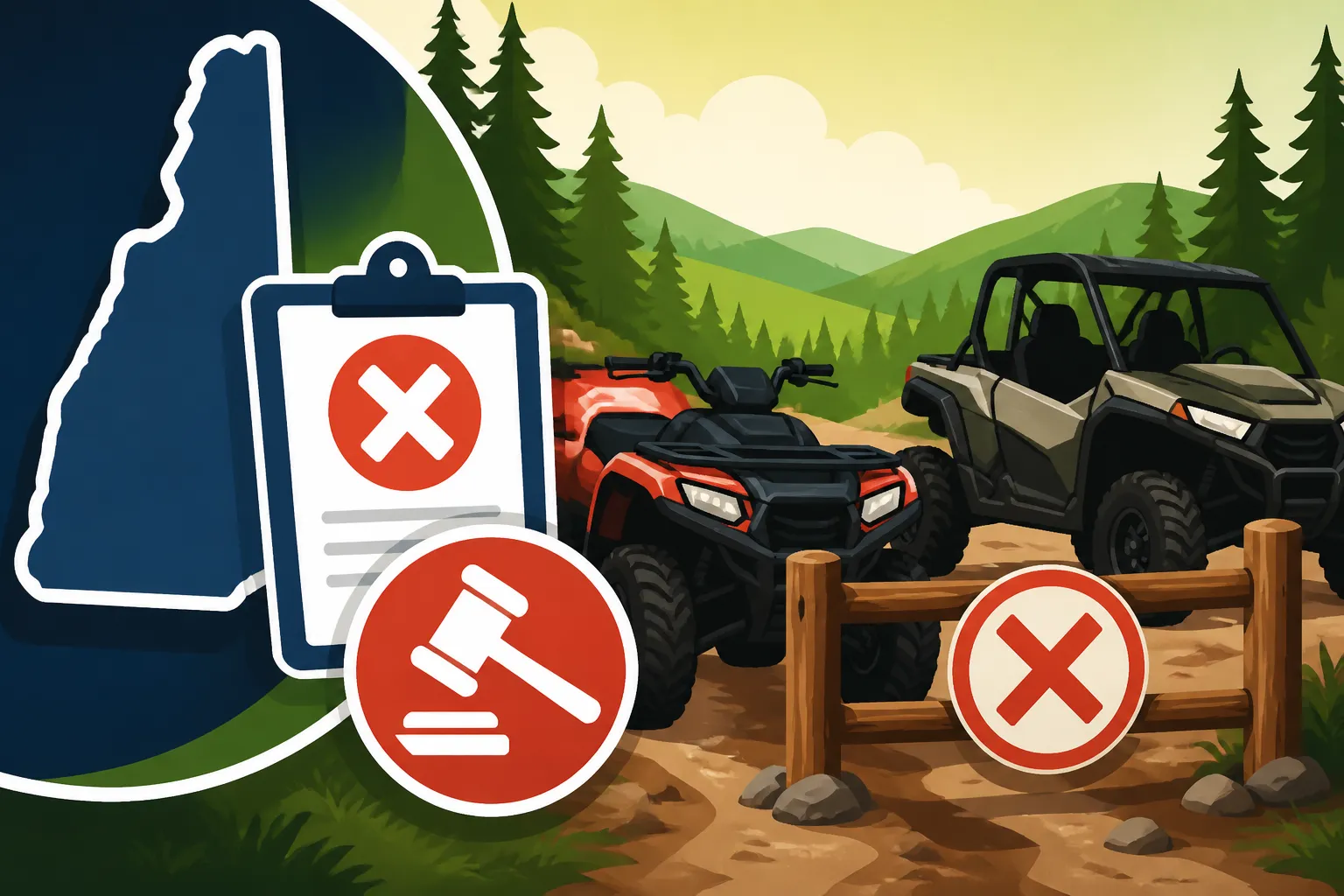
A closed-trail sign can turn a planned ATV or UTV ride into a citation, even if the trail looks passable or your machine is properly registered. The consequences depend on the circumstances and the violation cited, so there is no safe assumption that a warning—or a particular fine—will apply. Here’s how to understand closures, what to do if you’re stopped, and how to avoid riding somewhere you shouldn’t.
What riding a closed trail means
A trail closure means you should not ride that route while the restriction is in effect. The trail may be blocked by a gate, marked with a sign, included in an official closure notice, or closed through a landowner’s decision. A route can also become unavailable because of seasonal conditions, maintenance, logging, or a safety problem.
The important point is that a trail looking open is not proof that it is open to OHRVs. A gate may be temporarily open for work, a sign may be farther along the route, or a closure notice may apply even when the trail is physically passable. Conversely, a trail might have a confusing or damaged sign. If you are unsure, stop and check rather than ride farther to investigate.
Closures can apply to a full trail system or to one short segment. A detour or connector may also be closed while nearby trails remain available. Do not assume that a route is open just because you entered it from an open trail or because other riders are already using it.
Common reasons for closures include:
- Wet or fragile ground. Heavy use during mud season or after rain can damage the trail and make repairs more difficult.
- Maintenance or construction. Crews may need space to repair a bridge, culvert, or trail surface.
- Logging and other work. A road or trail may be used by trucks or equipment, creating a hazard for riders.
- Landowner restrictions. A landowner may withdraw permission or close access to protect property, address a problem, or allow work to take place.
- Seasonal limits. Some trails are available only during a defined part of the year. Local systems can have different opening and closing dates.
- Safety or emergency conditions. A washout, fallen tree, flooding, fire risk, or other hazard can make a route unsafe.
The reason for the closure matters, but it does not give a rider permission to ignore it. A route closed for a day of maintenance is still closed to recreational riding during that restriction. The details can vary by location, so check the relevant club or trail system’s status information before leaving. New Hampshire Trail Status Before You Ride and Checking the Trail Status Board offer related guidance on checking conditions.
A closure is different from registration
New Hampshire registration is not a pass that grants access to every trail. A registration and its decals address the machine’s registration requirements; the rider must still follow access rules and closures. Likewise, being a club member, buying a registration through a club, or carrying a current certificate does not override a closed-trail notice.
Keep these questions separate:
- Is the machine properly registered for the ride?
- Is this trail open to this type of machine today?
- Do you have permission to use the land and route?
- Are there additional limits, such as width restrictions or seasonal rules?
A “yes” to the first question does not answer the other three. For more on the difference between access and registration, see New Hampshire OHRV Permits Explained and Why Your Registration Is the Access.
| What you encounter | What it may mean | Prudent response |
|---|---|---|
| A closed sign at a trail entrance | Access is restricted at that entrance or beyond it | Do not enter; check for an official detour |
| A gate across a trail | The route may be closed, even if the gate is open or passable | Do not ride around or through it unless an authorized person clearly permits access |
| A closure notice for one segment | Other routes may remain open, but the named segment does not | Confirm the map and use only an approved alternative |
| A damaged or missing sign | The trail’s current status may be unclear | Stop and check with the responsible club, land manager, or authority |
| A trail that looks dry and usable | Physical condition alone does not establish permission | Verify its status before continuing |
| Another rider going through a closure | Their presence does not authorize your ride | Do not follow them into the closed area |
What fines and other consequences may follow
A rider who enters or continues along a closed trail may face a citation or other enforcement action. The exact consequences depend on the applicable law, the facts of the encounter, and what the officer or other authorized person alleges. Do not rely on an online estimate or another rider’s story as a prediction of what will happen in your case.
There is no single fine that can be safely applied to every closed-trail situation. A citation may identify a specific violation, and the amount or outcome can depend on the offense and the process that follows. If you receive paperwork, read the cited provision and instructions carefully. For general context about how violations may be handled, see New Hampshire Fines for an OHRV Violation and New Hampshire Fines for Riding a Closed Trail.
The conduct surrounding the closure can matter. For example, an officer may be concerned not only with whether a rider entered a closed segment, but also with whether the rider ignored a sign, went around a barrier, continued after being told to stop, or caused damage. These facts can change how an encounter is handled. They do not mean that every such case will result in the same charge or outcome.
Other issues may also be relevant. A rider might have a separate registration problem, be riding outside an allowed area, or lack permission to use private land. Those are not interchangeable with a closed-trail allegation, and each should be addressed on its own terms. A valid registration does not erase a closure violation, while a closed-trail citation does not automatically prove every other possible allegation.
Possible practical consequences include:
- A citation or notice to appear. The paperwork should tell you what violation is alleged and what response is required.
- A court or administrative process. The next step depends on the document and the authority involved. Follow the instructions on the citation rather than guessing.
- Additional costs. Any amounts, fees, or other obligations depend on the case and must be confirmed through the appropriate official channel.
- A record of the incident. An enforcement contact can be documented even if the situation does not end with the consequence a rider expected.
- Separate liability for damage or trespass. If the ride damaged land or involved access without permission, other issues may arise. The details depend on the facts and the applicable rules.
A warning is possible in some encounters, but riders should not treat it as an entitlement. The officer’s assessment, the type of closure, the rider’s conduct, and the condition of the route may all influence how the situation proceeds. The sensible plan is to avoid entering the closed trail in the first place.
Do not assume the closure is only advisory
A closure may be posted by a club, landowner, agency, or other party responsible for the route. A club’s trail-status notice may communicate a landowner’s restriction or a condition that makes access unsafe. Even where a rider does not know who posted the closure, that uncertainty is not a reason to keep going.
If you believe a sign is obsolete, unclear, or placed by mistake, do not settle the question by riding past it. Stop, record what you can safely observe, and contact the organization responsible for the trail. Keep any answer or permission in writing where practical. A club trail’s availability depends on permission and access arrangements, which can change. When a Landowner Takes Back Riding Permission explains why access can be withdrawn, and New Hampshire Written Permission Requirements covers permission for private land.
A closed trail can create more than one problem
A single ride can involve several distinct questions: whether the trail was closed, whether the machine was registered, whether the rider had permission, and whether any equipment or age rules were followed. A citation for one issue does not automatically resolve the others.
For example, a rider may have a current decal but still be on a closed route. A visitor may have a valid registration from home but still need to follow New Hampshire’s rules for riding here. A machine parked beside a trail may be legally transported, yet its operator may not have permission to ride the land. When reviewing an incident, separate each allegation and look at the paperwork that actually names it.
If you need to understand a registration-related allegation as well, [New Hampshire Fines for No Registration] is a separate topic. Avoid treating it as the same issue as a closed-trail citation.
How closures are enforced and what to do at a stop
Enforcement can happen at a trail entrance, along a route, or after a report about riding in a closed area. Signs, gates, barriers, trail notices, and information from a landowner or club may help establish that access was restricted. A rider should not assume that an officer must catch them at the sign for a closure to matter.
A stop is stressful, but arguing on the trail rarely improves the situation. Be calm, stop safely, and follow lawful instructions. Do not move a barrier, conceal the machine, or continue riding to get away from the encounter. If you are unsure what the officer is asking, ask a brief, respectful question. Do not guess at facts or make claims you cannot support.
If an officer issues a citation or gives you a written notice:
- Read the document before you leave. Check the alleged violation, the date and location, and any instructions about response, payment, or appearance.
- Ask what the next required step is. If the instructions are unclear, ask where to obtain clarification. Do not assume that paying, calling, or appearing is optional.
- Keep the paperwork. Store the citation, any related notices, and records of communications in one place.
- Write down your recollection promptly. Record the route you took, where signs or gates were located, what you saw, and what was said. Stick to facts rather than conclusions.
- Preserve relevant evidence. If you already have lawful photos, a trail map, or a current status notice, keep a copy. Do not return to a closed area to gather evidence.
- Follow the official process. Use the directions on the citation or confirm them with the court or agency identified in the paperwork.
- Get qualified advice if needed. If you dispute the allegation or face consequences you do not understand, consult a qualified professional.
A rider may have a reasonable explanation: the sign was obscured, the closure notice was not available where they checked, or they misunderstood which segment was restricted. Those details do not automatically cancel a citation. They may, however, be relevant when explaining what happened through the proper process. Avoid posting assumptions or arguments online instead of meeting the response requirements shown on official paperwork.
When the sign or trail status is confusing
If a sign is damaged, missing, or inconsistent with a map, stop before entering the uncertain area. Note the location and contact the trail organization or responsible land manager. If you are already on the trail when you encounter a closure, do not continue beyond it. Turn back using a safe, permitted route if possible. If turning around would itself create a safety problem, contact the appropriate authority or trail representative for direction.
A map can become outdated, and a status page may not capture a sudden closure immediately. When sources conflict, treat a clear on-the-ground closure as a reason to pause and verify. Do not assume that an old map or a previous ride settles today’s access.
How to avoid a closed-trail citation
The most reliable way to avoid a closed-trail citation is to make trail status part of ride planning, not something you check only after reaching a gate. Closures can be local and temporary, so a route that was open on a previous visit may not be open today.
Use this routine before each ride:
- Identify the exact trail system and route. A nearby trail can belong to a different club or land manager and have different rules.
- Check current status information. Look for closure notices, opening dates, temporary restrictions, and detours from the organization responsible for that area.
- Confirm machine limits. Width restrictions and other access rules may exclude a machine even when the trail itself is open.
- Check the signs at the staging area and along the route. A closure may have been posted after you checked online.
- Keep an alternative route in mind. If a segment closes, do not improvise by entering private land or riding along an unapproved road.
- Turn around at a closure. Do not go around the gate, lift a barrier, or use a narrow opening left for authorized work access.
- Update your information during the ride. If a club or land manager posts a new alert, follow it rather than relying on the plan made at home.
A useful status check should answer more than “Is this area open?” Look for the exact segment, the date the notice applies, the type of machine allowed, and whether the information describes a full closure or a detour. If the notice is unclear, contact the responsible organization before riding.
Respect gates and barriers
A gate is not an invitation to decide for yourself whether the closure is necessary. Riding around a gate can cause damage, bypass a restriction, or create a new route that was never approved. A barrier may also protect workers or direct riders away from a hazard that is not visible from the trail entrance.
Do not move, unlock, or bypass a gate unless an authorized person has clearly given you permission. If a gate is open, that alone does not prove the trail is open to recreational riders. Workers, landowners, or emergency personnel may need access while the public route remains closed.
Do not use neighboring land as a shortcut
A closure does not authorize a detour across private property, an unmarked field, or another trail that is not open to your machine. Permission to use one trail does not automatically include the land beside it. [New Hampshire Rules for Riding Off a Marked Trail] explains the risks of leaving an established route, while Why Unposted Land Is Still Off Limits addresses a common misunderstanding about private property.
If an approved detour is not clearly identified, stop and ask the club or land manager. Returning to a staging area may be inconvenient, but it is safer than turning a closure into a separate access or trespass problem.
Make the status check part of group planning
In a group ride, the person leading the route should confirm current access and make sure everyone knows the plan if a trail is closed. Riders should not split up to search for a way around a barrier. A passenger or another group member should not pressure the leader to continue just because the group has already traveled a long distance.
Before leaving, agree on a few simple rules:
- The first rider stops when a closure appears and alerts the group.
- Nobody crosses a barrier or sign while the group decides what to do.
- The group uses only a confirmed open detour.
- If no safe legal route is available, the group turns back.
- The leader shares any new closure information with everyone, including riders who started from another staging area.
This approach reduces confusion when people are unfamiliar with the system or using different maps. It also makes it easier to avoid an individual rider following the group into a closed area without realizing what the sign says.
If you believe a citation is incorrect
Disagreeing with a citation does not make it disappear. The citation will usually explain how to respond, and the instructions may include a deadline or a required appearance. Follow those directions and confirm any uncertainty with the court or authority named in the paperwork. Do not rely on a general online post for a deadline or procedure that applies to your case.
To prepare a clear account, organize the facts:
- The exact route and location where the contact happened.
- What signs, gates, or barriers were present and where they were placed.
- What trail-status information you checked and when you checked it.
- Whether the route was shown as open, closed, or subject to a detour.
- What the officer or other person told you.
- Any photos, messages, or maps you already had lawfully.
- Whether you stopped or turned around when you became aware of the restriction.
Be accurate about what you knew at the time. A route being open on a map earlier in the week is different from having checked it immediately before riding. A sign being difficult to see is different from there being no sign. Clear details are more useful than broad statements such as “everyone rides there” or “it looked open.”
If you believe the closure itself was unclear, ask the responsible club or land manager what restriction applied and when it took effect. Keep any response, but do not treat an informal explanation as a substitute for following the citation’s official instructions. For information about contesting a citation, see Appealing an OHRV Citation.
A closed-trail allegation can have legal consequences, and the right response depends on the document and facts. If you need advice about what to do, consult a qualified professional who can review your specific situation. Above all, do not ignore the notice or assume that a small-looking trail issue will resolve itself.
Frequently Asked Questions
Can I ride past a closed-trail sign if the trail looks safe?
No. A trail’s physical condition does not determine whether it is open to riders. The closure may be in place for reasons that are not visible, such as landowner restrictions, work, or a seasonal rule. Stop and verify the status rather than continuing.
Is there one fixed fine for riding a closed trail in New Hampshire?
Do not assume there is one amount that applies to every case. The outcome depends on the violation alleged and the circumstances. Read any citation carefully and confirm the current requirements with the official contact listed on the paperwork.
Does a current registration let me ride a closed trail?
No. Registration does not grant access to a closed route. Riders must follow current trail restrictions and have the necessary permission to use the land.
What should I do if I find a closure while already on the trail?
Stop before entering the closed area. Turn back by a safe, permitted route, and check with the responsible trail organization if the notice or detour is unclear. Do not ride around a barrier or cross neighboring land as an improvised shortcut.
What if the sign was missing or hard to see?
Record what you observed and raise the issue through the proper process if you receive a citation. A missing or unclear sign does not automatically determine the outcome, so follow the citation’s instructions and seek qualified advice if necessary.
Disclaimer
This article is for general informational purposes only and does not constitute professional advice. Laws, prices and regulations vary by location and change over time. Consult a qualified professional for guidance on your specific situation.