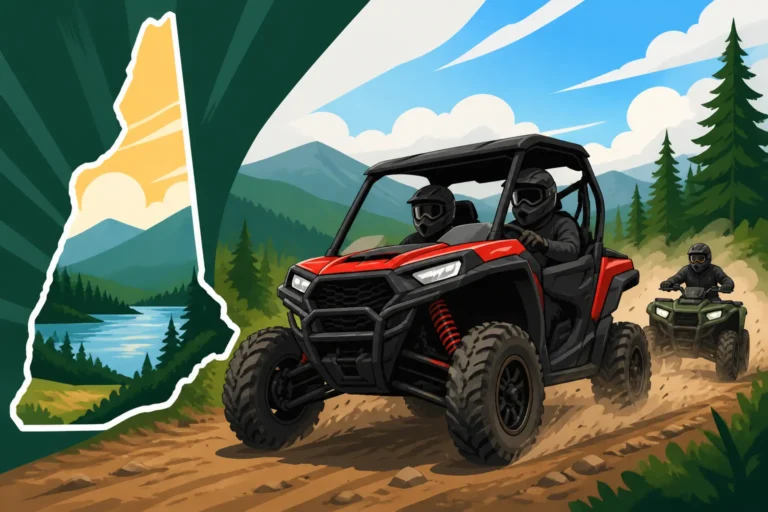
Camping at Jericho Mountain
Camping near Jericho Mountain can make a North Country ATV trip easier, but a campsite does not automatically answer every riding question. You still need to confirm where you can camp, whether your machine is registered, which trails are open, and how you will get from camp to the riding network. This guide helps you plan those details before you arrive in Berlin.
Choose a campsite that fits your riding plans
Check what camping is available at Jericho Mountain
Jericho Mountain State Park is in Berlin, in Coös County, and is a well-known base for exploring nearby OHRV trails. Camping options and park arrangements can change, so check directly with the park or the relevant New Hampshire state agency before you make plans. Confirm whether camping is available for your dates, what the site provides, and whether you need a reservation.
Do not assume that a campsite includes a riding permit, machine registration, or permission to use every trail in the area. Camping and riding access are separate things to verify. Ask whether the site is intended for tent camping, RVs, or both, and whether there are restrictions on trailers, generators, fires, pets, or the number of machines at a site.
If the park cannot accommodate your preferred setup, look at lodging and campgrounds in Berlin and nearby North Country communities. When comparing alternatives, ask how far the camp is from a legal trail access point. A place that appears close on a road map may still require you to trailer your ATV or UTV rather than ride directly from your site.
For a broader look at the park itself, see [Camping at Jericho Mountain]. If you are weighing a campground stay against other accommodation, [New Hampshire ATV Camping Near the Trails] can help you think through the practical trade-offs.
Find out whether you can ride from camp
“Near the trails” and “connected to the trails” are not the same. Before booking, ask the campground or park whether riders may leave the property on a machine, where the permitted connection begins, and whether the route passes over any road or private land. A short distance between your campsite and a trail does not give you permission to ride across a road shoulder, driveway, or neighboring property.
If you will need to trailer to a staging area, check the parking arrangements in advance. Make sure there is room for your truck and trailer, and ask whether overnight parking is allowed. On busy weekends, arriving with a long trailer and no confirmed place to leave it can turn the first hour of a trip into a frustrating search for space.
Use a current trail map and confirm that the route you plan to ride is open. An app such as onX Offroad can help you review routes and orient yourself, but do not treat a map line as proof that a trail is open or that access is permitted. Download any maps you intend to use before leaving home, then compare them with current information from the local club or trail authority.
Match the campsite to your group and machine
A campsite that works for a couple with a small ATV may not work as well for a family arriving with a side-by-side, a trailer, and several vehicles. Consider the full footprint of your setup: the machine, tow vehicle, trailer, tent or RV, and room to move around safely. Ask about site dimensions and parking rather than relying on a general description.
Think about the people who are not riding, too. If someone in your group wants a quieter evening, needs reliable facilities, or is traveling with children, those needs may affect which campsite or nearby lodging makes sense. A remote site can feel peaceful after a full day on the trails, but it can also mean more driving for supplies and fewer convenient alternatives if the weather changes.
Prepare your machine and paperwork before you go
Confirm New Hampshire registration requirements
Visitors should not assume that a registration from another state automatically authorizes riding in New Hampshire. Check what applies to your machine and the kind of riding you plan to do. The registration rules can depend on factors such as whether you are a resident or visitor, the machine type, and how long you intend to ride.
New Hampshire does not use a separate general trail pass in the same way some riders expect. Registration is an important part of riding access, but it is not a substitute for checking trail openings, land access, or local restrictions. For a visitor’s overview, read [Riding New Hampshire With an Out-of-State Machine] and [Why New Hampshire Has No Separate Trail Pass].
Carry the documents and display the decals as required. Before leaving home, confirm that your registration is valid for the dates of your trip and that the information corresponds to the machine you are bringing. If you are unsure about a registration detail, resolve it before travel rather than hoping to sort it out at a trailhead.
Bring the right documents and check your machine
Put your registration certificate and other relevant paperwork somewhere protected but easy to reach. A zippered document pouch or waterproof case can prevent rain, mud, and campsite spills from turning a simple roadside check into a scramble. Review [New Hampshire OHRV Registration Paperwork] for a practical checklist of the documents that may matter.
Inspect your ATV or UTV before the drive north. Check tires, brakes, steering, lights, battery connections, and fluid levels. Look over the trailer too, including its tires, lights, hitch, safety chains, and tie-downs. A machine that runs well around the yard can still develop trouble after a long tow followed by a demanding trail ride.
Pack basic repair and recovery supplies suited to your machine and route. Depending on the trip, that may include a tire repair kit, a small tool set, a tow strap, and spare gloves. Keep in mind that a repair kit does not replace a plan for getting help if the machine becomes disabled far from camp. Tell someone where you intend to ride and when you expect to return.
Review age, safety, and riding rules
If minors are riding, check New Hampshire’s age, supervision, and safety certificate rules for each rider. Requirements can differ by age and circumstance, so do not rely on what a young rider was allowed to do at home. Start with [New Hampshire Rules for Riders Under 18] and confirm the details that apply to your group.
Helmets and suitable eye protection are sensible essentials even when a rider believes an exception might apply. Trail surfaces can change quickly, and dust, branches, gravel, and other machines can make eye protection especially important. Bring gear that fits properly; a helmet that shifts or goggles that fog can make an otherwise enjoyable ride uncomfortable.
Before the trip, talk through basic group expectations: ride at a pace the least experienced person can manage, leave space between machines, and agree on what to do if the group gets separated. Keep children within the supervision required by law and within sight when practical. A clear plan is much more useful than trying to establish rules after someone has taken a wrong turn.
Plan your routes and campsite routine
Check trail status, width, and seasonal access
Trail access is not guaranteed just because the area is popular. Conditions, landowner decisions, maintenance, weather, and seasonal closures can affect what is available. Check current local trail information shortly before departure and again before setting out each day. A route shown on an older map may have a temporary closure or a restriction that affects your machine.
Width matters, particularly for side-by-sides. A trail system may include routes with different limits, so measure the machine as it is actually equipped, including any accessories that add width. Review [New Hampshire Trails for a Wide Machine] and do not assume that a machine that fits one section will fit every connector or branch.
A mapping tool such as onX Offroad may help you keep track of your location and planned route, especially when you have prepared maps in advance. Still, use local trail-status information to check access. If a gate is closed, a sign marks a restriction, or a club advises that a section is unavailable, do not use the app’s route line as a reason to continue.
Build a realistic daily ride plan
Choose a route based on the group’s experience, the machine’s range, and the time you have—not just the distance on the map. Stops, slower trail sections, road crossings, changing conditions, and navigation checks all add time. A loop that looks manageable on a screen can become a long day if the group has to backtrack or wait for a repair.
Plan fuel stops and make sure everyone understands the day’s route before leaving camp. If you are riding with a group, decide where you will regroup after a turn or a difficult section. Carry water, food, and weather-appropriate layers, and bring a charged phone or other navigation device. Cell service can be unreliable in parts of the North Country, so do not make a phone connection your only safety plan.
It can help to choose a shorter first ride, especially if you have not used the local system before. That gives you time to learn how the trails are signed, test your navigation setup, and return to camp before dark. Once the group has a feel for the terrain and access points, plan a longer outing if conditions and daylight allow.
Keep camp safe, considerate, and ready for the next ride
At camp, secure machines and gear when you are away from the site. Keep fuel and equipment stored according to campground rules, and follow posted instructions for fires, waste, and quiet hours. Do not ride around a campground unless the operator expressly allows it; a camping area is not automatically an OHRV route.
Mud and debris are part of trail riding, but cleaning a machine at camp may be restricted. Ask where washing is allowed and avoid directing muddy runoff toward neighboring sites, waterways, or shared facilities. Keep tools, helmets, and wet gear organized so the next morning does not begin with a search through a dark trailer.
Before bed, check the next day’s trail status and weather, then charge devices and put essential items in one place. If conditions change overnight, adjust the plan rather than feeling committed to a route simply because it was the original idea. A flexible schedule makes a camping trip more enjoyable and helps the group make safer decisions.
Use this checklist before leaving home
| What to confirm | Why it matters |
|---|---|
| Campsite dates and site details | Availability, facilities, and vehicle space can vary |
| Machine access from camp | Nearby trails may not connect legally to the campground |
| Registration and paperwork | Out-of-state registration may not be enough for New Hampshire riding |
| Trail status and machine-width rules | Closures and restrictions can affect your route |
| Trailer and staging parking | You may need to transport the machine to a permitted access point |
| Rider ages and safety requirements | Rules can differ depending on the rider |
| Fuel, navigation, and emergency plan | Remote riding may involve limited services and cell coverage |
| Campground rules | Fires, washing, storage, and machine movement may be restricted |
A smooth Jericho Mountain camping trip depends on treating camping, registration, and trail access as separate pieces of the plan. Confirm the campsite directly, verify current trail conditions, and make sure your machine and group are ready before you travel. For a closer look at the wider area, [New Hampshire ATV Trails Near Berlin] and [New Hampshire's Jericho Mountain Trails] are useful next reads. If your plans depend on local trail openings, also review [New Hampshire Trail Status Before You Ride].
Disclaimer
This article is for general informational purposes only and does not constitute professional advice. Laws, prices and regulations vary by location and change over time. Consult a qualified professional for guidance on your specific situation.