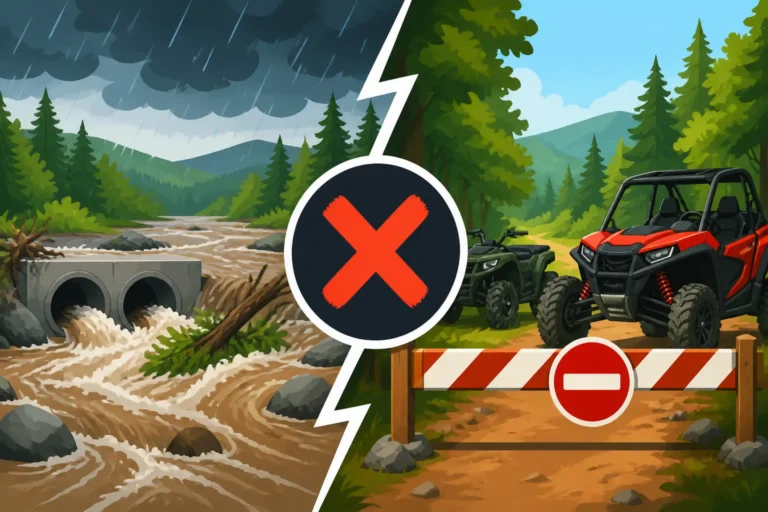
Riding a New Hampshire Trail in November
November riding in New Hampshire can mean a quiet trail, a surprise snow squall, or a closed gate where you expected an open route. The key is that there is no single statewide November season for ATVs and UTVs: access depends on the trail, landowner, club, and current conditions. This guide explains how to check before you haul north and how to ride responsibly if access is open.
Can you ride an ATV or UTV in New Hampshire in November
Sometimes—but November is not a reliable month for riding the state’s full summer trail network. Many club trails close in October, and a route used by ATVs in summer may become a snowmobile corridor in winter. A trail shown on an old map, or one that looks passable from the road, is not proof that OHRVs are allowed there now.
The safest approach is to treat every route as closed until you confirm that it is open to your type of machine on the day you plan to ride. Start with the club or land manager responsible for the route, then check for posted signs and restrictions at the trailhead. These steps matter even if you rode the same trail in September.
Expect club trails to close on different dates
There is no one closing date that applies to every New Hampshire trail. Some club systems close in mid-October, while others may remain open later in the month. Individual trails can also close earlier because of weather, landowner requests, maintenance, or conditions that would be damaged by riding.
That variation is especially important in northern areas such as Coos County, around Berlin, Gorham, and Pittsburg. A route that appears connected on a map may cross multiple club areas, each with its own status. If one section is closed, you may not be able to complete the planned loop even if the rest of the route remains open. For more background, see [New Hampshire's October Closing Dates] and [Why October 12 Ends Some Trails].
Snowmobile trails are not automatically ATV trails
As temperatures drop, a summer trail may be prepared for snowmobile use. That does not mean ATVs and UTVs can continue using it before snow arrives or after the surface freezes. The allowed use depends on the trail designation and current permission, not simply on whether the route is physically passable.
Avoid riding around a gate, closure sign, or barrier because the ground looks firm. A closed trail may cross private land, be managed for a different season, or be particularly vulnerable to damage during freeze-thaw weather. Learn more about seasonal corridors in [Why a Snowmobile Corridor Shuts in Summer] and [Sharing a Corridor With Snowmobiles].
How to confirm a November trail is open
A little checking before departure can save a long drive with a trailer and prevent an unpleasant conversation at a closed trailhead. Do not rely on a single map or a social media post from earlier in the fall. Look for recent information from the club or organization responsible for the exact area you want to ride.
Check the trail manager’s latest status
Start with the relevant ATV club or trail manager and look for a recent trail-status update. If the information is unclear, contact the organization directly and ask about the specific segment, not just the general system. A useful question is: “Is this route open to ATVs or UTVs today, and are there any seasonal, width, or access restrictions?”
That level of detail matters on a long route. A trail could be open in one town but closed after a connection, or access may be limited to a certain machine width. If you’re considering a route around Berlin or Gorham, check the clubs responsible for each leg rather than assuming one town’s status applies to the next. [New Hampshire Trail Status Before You Ride] and [Clubs That Post Trail Conditions Every Day] are useful starting points for planning what to verify.
Use maps as planning tools, not permission
Digital mapping tools, including onX Offroad, can help you orient yourself, compare route options, and keep track of where you are. They are useful when planning a trip through unfamiliar terrain or trying to understand how trails connect. But a map cannot grant access, guarantee a route is open, or replace a current closure notice.
Before leaving home, compare your planned route with the latest information from the trail manager. Once you arrive, follow signs and gates even if your map shows a line continuing ahead. It also helps to save the route for offline use, since cell service can be limited in parts of the North Country. You can read more about that practical challenge in [Cell Dead Zones in the North Country].
| Before you ride | What to verify |
|---|---|
| Trail status | The route is currently open to OHRVs, not just shown on a map |
| Seasonal permission | ATV or UTV use is allowed in November |
| Route connections | Every club area and segment on your planned loop is open |
| Machine fit | Your vehicle meets any width or other trail restrictions |
| Trailhead conditions | Gates, signs, and posted notices match the information you checked |
| Weather and surface | Recent rain, snow, ice, or thaw has not made riding unsafe or damaging |
Confirm access for the whole route
A route that crosses a town line, a club boundary, or privately owned land can involve several different permissions. Confirm access for each section, especially if your plan includes a connector trail or a road segment. If you cannot establish that a segment is open, plan an alternate route rather than deciding to investigate from the seat of your machine.
This is one place where a map app can help with orientation while direct status checks do the legal and practical work. For instance, onX Offroad might help you see where your intended loop turns or branches, but the club’s current notice is what you need to confirm before riding. Keep a backup plan that ends at the staging area, and don’t assume a nearby open trail makes a closed connection usable.
What November trail conditions can be like
Even when a trail is open, late-fall conditions can change quickly. A route that was dry in the morning may become slick after rain or a temperature drop. In the North Country, snow, frost, ice, wet leaves, and muddy sections may appear within the same ride. November also brings shorter daylight, which leaves less time to deal with a detour or mechanical problem.
Prepare for freeze-thaw and surface damage
A surface that looks frozen can soften as the day warms, especially in shaded hollows, low spots, and wet areas. Riding through soft ground can deepen ruts and damage a trail that clubs and volunteers work to maintain. If your tires begin to sink, spin, or leave pronounced tracks, turn around rather than trying to power through.
After rain or a thaw, consider postponing the ride if the trail is visibly saturated. This is not just about keeping your machine clean; trail damage can prompt closures and create extra repair work for volunteers. If you’re unsure how the route is holding up, check for current local information before setting out. [New Hampshire Trail Conditions Before You Ride] explains why checking conditions is part of planning, not an afterthought.
Plan for cold, darkness, and limited service
Dress for the temperature and wind you may encounter on the machine, not just the weather at the parking area. Bring layers, gloves that stay warm when damp, eye protection, and a way to keep your phone and other essentials protected from cold and moisture. Check that your lights work before departure, and leave enough daylight to return without rushing.
Tell someone where you intend to ride and when you expect to be back. Carry a charged phone, but do not count on having a signal throughout a remote route. A downloaded map can help you stay oriented when service drops; onX Offroad is one option for offline route reference, but bring a backup power source and know how to return to your staging area if your phone fails.
Be alert during hunting season
November overlaps with hunting activity in many parts of New Hampshire. Wear blaze orange where appropriate, keep your machine on authorized trails, and be considerate around hunters and other trail users. Don’t assume an empty trail is unused simply because you haven’t seen anyone yet.
Respect posted land and any seasonal restrictions. A trail can run through a landscape used by several groups, and riding outside the marked route can create conflict or damage the land. Check [Sharing a New Hampshire Trail With Hunters] before your trip, and follow any instructions from landowners, clubs, or officials.
How to plan a safer November ride
A November trip works best when the ride is built around confirmed access rather than a preferred mileage target. Choose a staging area, identify a short route that can be verified end to end, and make a decision point where you can turn back if conditions have changed. Be willing to cancel: a wasted drive is frustrating, but riding a closed or unsafe trail can create much bigger problems.
Choose a conservative route and a clear turnaround point
For a first late-season ride, avoid ambitious loops that depend on several uncertain connections. Pick a route with a known open status, keep the distance manageable, and identify a sensible turnaround point. That gives you room to adjust if the surface is worse than expected or daylight fades sooner than planned.
If you’re heading toward the Berlin or Gorham area, don’t assume that a destination or trail network remains open simply because it is popular during the main riding season. Check current access for the specific route and staging location. You can also consult [New Hampshire Trail Maps From a Club] for route-planning context, while confirming the actual November status with the responsible club.
Check your machine and carry basic recovery gear
Before leaving, inspect tires, brakes, lights, battery, and fuel. Cold weather can make small mechanical issues more consequential, especially when you are far from a paved road or reliable cell coverage. Bring the tools you know how to use, a first-aid kit, water, food, and warm clothing.
Think through what you would do if a machine became stuck or stopped running. A tow strap or other recovery equipment is only useful if it is appropriate for your vehicle and you know how to use it safely. Avoid improvising a recovery that could injure someone or damage the machine. If a trail is too soft, icy, or steep for a safe return, the better choice is to turn around before you need recovery.
Keep the trip flexible
Check the forecast again before loading the trailer, and be ready to change plans if snow, heavy rain, or a sharp temperature swing is expected. A short ride on a confirmed route may be a better November outing than trying to salvage a full-day plan on uncertain trails. If access closes, do not ride past the closure or look for an unmarked way around it.
Keep your route notes simple: where you’re staging, which segments are confirmed open, where you will turn back, and who knows your plan. Use onX Offroad or another map tool for navigation if helpful, but pair it with local trail-status information and what you see at the trailhead. A careful plan lets you enjoy the ride without treating every gate or changing patch of weather as a surprise.
Disclaimer
This article is for general informational purposes only and does not constitute professional advice. Laws, prices and regulations vary by location and change over time. Consult a qualified professional for guidance on your specific situation.