Registering a Quad You Keep at a Camp
It's such a dream, isn't it? Owning a camp in New Hampshire – maybe nestled in the vast expanse of Coos County or tucked away by a quiet lake in the Lakes Region – and having your quad or side-by-side right there, ready for adventure at a moment's notice. The thought of skipping the whole trailering hassle, especially after a long week, is incredibly appealing. But then a little voice in the back of your head pipes up: "What about registration? Does it work differently if the machine mostly lives at the camp instead of my main residence?" It's a valid question, and one that can cause a bit of confusion for New Hampshire residents and out-of-staters alike. This comprehensive guide is here to clear up all those registration mysteries, ensuring your camp-based OHRV is legal, properly documented, and ready to hit the trails the moment you arrive.
Understanding New Hampshire's Registration Philosophy for Camp-Based Machines
When it comes to registering an Off-Highway Recreational Vehicle (OHRV) in New Hampshire, the state largely focuses on the machine itself and the owner's residency, not necessarily the physical address where the OHRV is stored for most of the year. This distinction is incredibly important, especially if your camp is in New Hampshire but your primary residence is in another state. Many folks assume that because their quad is in New Hampshire, it automatically qualifies for resident rates, but that's often not the case.
Think of it this way: New Hampshire wants to know who legally owns the machine and whether that person is a resident of the state. The camp's physical location is where you'll use the OHRV, but it doesn't define its registration status. So, whether your ATV is parked in your garage in Nashua or tucked away in a shed at your seasonal camp in Pittsburg, the fundamental requirements for [Registering an OHRV in New Hampshire] remain the same. The key takeaway here is to clarify your own residency status first and foremost, as this will dictate much of the registration process and the fees you'll pay. Don't let the convenience of having your machine at the camp lead you to overlook these crucial details!
Why Your Residency, Not Your Camp's Location, Is Key
Let's dive a bit deeper into this residency nuance. Imagine you live primarily in Massachusetts, but you own a beautiful camp in Errol, New Hampshire, where your UTV lives from May to October. Even though your UTV spends six months a year in New Hampshire, you are still considered a non-resident by the New Hampshire Fish and Game Department for registration purposes. This means you will pay the non-resident registration fees. Conversely, if you reside full-time in Concord, New Hampshire, and keep your quad at a hunting camp in Milan, you're a New Hampshire resident, and you'll pay the resident rates.
This system ensures fairness in how funds are collected and distributed, with resident fees often being lower as residents also contribute to the state's tax base in other ways. It's not about penalizing camp owners; it's about applying a consistent standard based on an individual's legal domicile. So, before you even start gathering paperwork, be absolutely clear about your primary, legal residence. This will save you a lot of time and potential frustration down the road when you encounter the different fee structures.
The Role of Club Membership for Camp-Based Riders
For those of us with camps, particularly in areas rich with OHRV trails like the Great North Woods, joining a local OHRV club can be a real game-changer, both for community and for your wallet. Many clubs actively maintain the very trails you'll be riding near your camp, from clearing downed trees to grooming in the winter, and they rely on membership dues and volunteer hours to do it.
New Hampshire incentivizes this support by offering a significant discount on OHRV registration fees for club members. This applies whether you're a resident or a non-resident. For example, a resident who is a club member pays a lower rate than a resident who isn't. The same goes for non-residents. [Why Club Membership Saves $30 in New Hampshire] is a benefit that applies universally. So, if your quad lives at your camp and you plan to ride frequently, consider joining a club like the Metallak ATV Club if you're in Colebrook, or the Milan Trail Huggers if you're closer to Dummer. Not only do you save money on your registration, but you also directly support the trail network that enhances your camp experience. It's a win-win, offering community, trail access, and a financial benefit.
Gathering Your Paperwork for a Camp Quad Registration
Now that we've established the residency aspect, let's talk about the nitty-gritty: the paperwork. Whether your quad is brand new from a dealer or a trusty used machine you picked up from a neighbor near your camp, you'll need specific documents to get it legally registered. This is where most people hit a snag, especially if they bought a machine privately and didn't realize the importance of a proper paper trail. Having all your ducks in a row before you head to an agent or try to register online will make the process infinitely smoother.
The state needs proof of ownership to ensure the machine isn't stolen and that you're the rightful party to register it. For many of us, especially with older, used machines that have been passed down or bought in a casual transaction, this can be a bit of a scramble. Don't worry, though; it's manageable with the right approach.
Proof of Ownership: The Bill of Sale or Previous Registration
The single most critical piece of documentation is proof that you own the OHRV. New Hampshire does not issue titles for OHRVs, which can sometimes make tracking ownership a little less formal than with, say, a car. This is why a clear and complete bill of sale is paramount, especially if you're buying a used machine for your camp.
- For a new machine: If you bought your quad from a New Hampshire dealer, they'll typically handle much of the initial paperwork and provide you with a Manufacturer's Statement of Origin (MSO) or Certificate of Origin (COO), along with a bill of sale. They might even process the registration for you right there, making it incredibly convenient.
- For a used machine bought privately: This is where you absolutely need a detailed [New Hampshire ATV Bill of Sale Requirements]. It should include:
- The date of sale.
- The full names and addresses of both the buyer (you) and the seller.
- A clear description of the OHRV, including make, model, year, and importantly, the Vehicle Identification Number (VIN) or Hull Identification Number (HIN).
- The purchase price.
- Signatures of both parties.
Having a template from a reputable source can be extremely helpful here. For instance, services like LawDepot offer customizable bill of sale forms that can ensure all necessary details are included, providing clear documentation of the transaction. This can prevent headaches later if there's any question of ownership.
- For an inherited machine: If the quad was willed to you for the camp, you'll need the will or probate documents showing you as the legal heir, along with the previous owner's registration.
- If you have the previous registration: If the seller provided you with their most recent New Hampshire OHRV registration certificate, that's excellent. It serves as strong proof of the machine's history and prior ownership. You'll still need a bill of sale to prove the transfer to you, but the previous registration provides context.
Remember, if you show up to register your machine with just a handshake agreement and no paperwork, you're going to hit a wall. Always insist on a proper bill of sale.
| Required Documents for OHRV Registration | New Purchase (Dealer) | Used Purchase (Private) | Inherited Machine |
|---|---|---|---|
| Proof of Ownership | MSO/COO, Dealer Bill of Sale | Signed Bill of Sale (LawDepot) | Will/Probate Docs, Bill of Sale |
| Previous NH Registration | Not applicable | Recommended (if available) | Required (if available) |
| Valid Photo ID | Yes (Driver's License/State ID) | Yes (Driver's License/State ID) | Yes (Driver's License/State ID) |
| Proof of Club Membership | Optional | Optional | Optional |
| Completed Application | Yes | Yes | Yes |
Your Personal Identification and the Application
Beyond the proof of ownership for the machine itself, you'll also need to prove who you are. A valid driver's license or state-issued photo ID is essential. This confirms your identity and residency status, which, as we discussed, directly impacts your registration fees.
You'll also need to complete [The New Hampshire OHRV Registration Application]. This form asks for details about the OHRV (make, model, VIN, etc.) and your personal information. You can often find this application online on the New Hampshire Fish and Game website, or you can pick one up at any registration agent. Filling it out neatly and completely before you go can save time at the counter. Double-check all the numbers and spellings to avoid any errors that could delay your registration. This form, coupled with a well-drafted bill of sale, perhaps generated through a service like LawDepot to ensure accuracy, forms the backbone of your registration packet.
Navigating Resident vs. Non-Resident Registration for Your Camp Machine
This is often the most confusing part for camp owners. As a quick refresher, your residency for OHRV registration in New Hampshire is determined by your primary, legal domicile, not by where your OHRV is kept. This means if your camp is in New Hampshire but you live primarily in Maine, you are a non-resident. If you live in New Hampshire year-round, you're a resident, even if your machine only sees your camp for a few weekends a year. Understanding this distinction is vital because it directly impacts the [New Hampshire OHRV Registration Cost] you'll incur.
The fees are structured to reflect the state's recognition of contributions from permanent residents versus those who visit seasonally. It's not about being exclusive; it's about equitable funding for trail systems and OHRV programs.
New Hampshire Resident Rates
If you are a bonafide resident of New Hampshire – meaning your driver's license, voter registration, and primary tax filings are all in New Hampshire – you qualify for the resident rates. These rates are generally the lowest available and are further reduced if you are a member of a recognized New Hampshire OHRV club.
For example, a New Hampshire resident registering a typical wheeled OHRV will pay one rate, but if they are a member of an approved OHRV club, that rate is notably lower. This discount is a fantastic incentive to support the clubs that do so much for the trails you enjoy around your camp. It truly makes a difference in maintaining the quality and accessibility of the trail network, like the vast Ride the Wilds system that connects many northern New Hampshire camp areas.
Non-Resident Rates and the Club Member Discount
If your primary residence is outside of New Hampshire, even if your camp and OHRV are within its borders for extended periods, you will be registering as a non-resident. The non-resident fees are higher than resident fees, which is common practice in many states for recreational registrations. However, the good news is that non-residents can also take advantage of the club member discount!
So, if you're a non-resident camp owner, joining a New Hampshire OHRV club makes even more financial sense. Not only does it connect you to the local riding community and support the trails you use near your camp, but it also provides a substantial saving on your registration. This can often offset a significant portion of the annual club dues, effectively making your club membership pay for itself while also getting you involved with the folks who work hard to keep the trails open. For many non-resident camp owners, this is a no-brainer. You get to enjoy the trails, save some money, and be part of the solution. [What a Nonresident Pays in New Hampshire] is significantly reduced with a club membership.
The Specifics of Your Camp's Address on the Application
While your residency determines the rate, the application will ask for your current mailing address, which for many camp owners, might be their out-of-state home address. It will also ask for details about the machine's location, which is where you would list your New Hampshire camp address. This is perfectly normal and expected. The key is to be truthful about your legal residency status and ensure the mailing address is where you want your official registration certificate and any correspondence to be sent. Don't try to use your camp address as a primary residence unless it genuinely is your legal domicile, as misrepresenting this could lead to issues.
Where and How to Finalize Your Camp Quad's Registration
Alright, you've got your paperwork in order, you understand your residency status, and maybe you've even joined a local OHRV club. Now it's time to make it official and get those decals! New Hampshire offers several convenient ways to register your OHRV, so you can choose the option that best fits your schedule and location, especially when you're at your camp.
Knowing [Where to Register an OHRV in New Hampshire] is crucial, as not all agents offer every service, and some methods are simply more efficient than others. The goal is to get your official registration certificate and the two decals that prove your machine is legal for New Hampshire trails.
Registering at a Local Town Clerk or Agent
For many camp owners, especially those who spend significant time in New Hampshire, visiting a local town clerk's office or an authorized registration agent is the most common and often easiest way to register. These agents are typically found in town halls, some general stores, or even powersports dealerships across the state.
- Convenience: If you're already at your camp, there's likely a town clerk or agent in a nearby town. For example, if your camp is in Stratford, you could visit the Stratford Town Clerk. They process registrations directly, and you walk out with your decals and certificate right then and there.
- Proof of Membership: If you're claiming a club member discount, make sure to bring proof of your current club membership (e.g., your membership card or a confirmation email). The agent will need to verify this to apply the lower rate.
- Payment: Be prepared to pay the registration fee. Most agents accept cash, checks, and often credit/debit cards, but it's always wise to confirm payment methods beforehand.
This in-person method is great because you can ask any questions you have and resolve issues on the spot. Just remember to bring all your documentation, including a completed application, proof of ownership (like your bill of sale, which could be a LawDepot generated document), your ID, and club membership proof if applicable.
Registering Through a Powersports Dealer
If you've recently purchased a new or even a used OHRV for your camp from a New Hampshire powersports dealer, they often offer the convenience of handling the registration process for you as part of the sale. This is a huge time-saver and ensures all the paperwork is correctly filed. They are authorized agents and can issue your registration and decals right when you complete the purchase. This is by far the easiest method for new machines, as the dealer is well-versed in the requirements and can seamlessly integrate the registration into your purchase.
Online Registration and Mail-In Options
For renewals, or if you prefer to handle things remotely, New Hampshire does offer online registration services through the Fish and Game Department's website. This is a convenient option if you're renewing an existing registration for your camp quad from your primary residence out-of-state, or simply want to avoid a trip to an agent.
- Online Portal: The online system is generally user-friendly for renewals. You'll need your previous registration information. New registrations (for machines never before registered in your name) sometimes require more documentation and might still necessitate an in-person visit or mail-in.
- Mail-in: You can also mail in your completed application, proof of ownership, and payment to the Fish and Game Department. While this works, it does take longer due to processing and mail transit times. This might not be ideal if you're planning a last-minute trip to the camp and need your registration immediately.
Always allow ample time if using online or mail-in options, especially if you're planning a trip to your camp soon after. You don't want to arrive at the trailhead only to realize your decals haven't arrived yet!
What You Receive and Where It Goes
Once your registration is processed, you'll receive a printed registration certificate and two OHRV decals.
- The Certificate: This is your official proof of registration. Keep it with you when you ride your OHRV. Many riders keep it in a waterproof bag or a storage compartment on their machine. It's often recommended to have the physical certificate, not just a photo on your phone, as an officer may ask to see it.
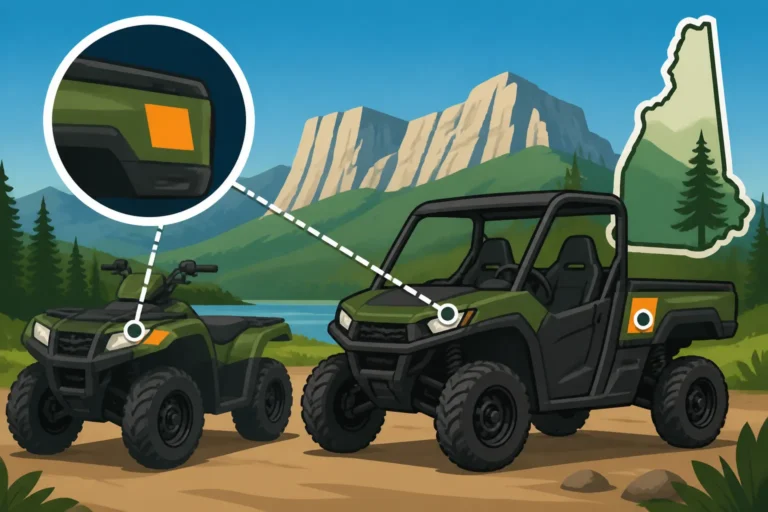
- The Decals: You'll get two matching decals, which are color-coded to indicate the registration year. These must be prominently displayed on your OHRV. For ATVs, they typically go on the front and rear fenders. For side-by-sides, they are often placed on the hood/fender and the rear panel. Ensure they are clean, visible, and securely attached. These [New Hampshire OHRV Decals and the Certificate] are your visual proof to law enforcement and trail managers that your machine is legally registered to ride New Hampshire's fantastic trail system. If your camp is in an area known for strong winds or tough weather, make sure those decals are really stuck on well!
Having your quad registered and ready at your New Hampshire camp is truly one of life's simple pleasures. By understanding these registration nuances, you can focus less on paperwork and more on enjoying the incredible trails that the Granite State has to offer. Happy riding!
Disclaimer
This article is for general informational purposes only and does not constitute professional advice. Laws, prices and regulations vary by location and change over time. Consult a qualified professional for guidance on your specific situation.