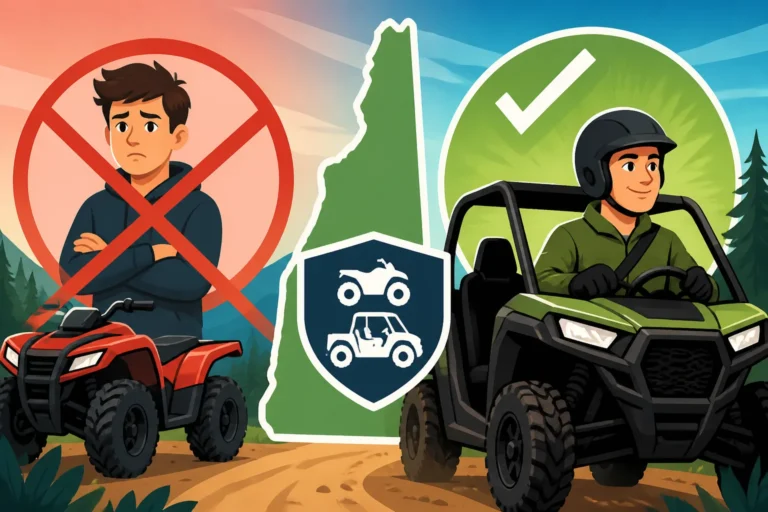
What Happens If Your Certificate Is at Home
There's nothing quite like that sinking feeling in your stomach when you're geared up, machine fired up, maybe even pulling into the trailhead, and suddenly it hits you: your New Hampshire OHRV registration certificate is sitting neatly on your kitchen counter. We've all been there, or at least worried about it. That little piece of paper, easily overlooked in the rush to hit the trails, is actually a crucial document, and forgetting it can throw a serious wrench into your day of adventure. This guide is here to walk you through exactly why that certificate is so important, what can happen if you don't have it on you, and how to make sure it's always along for the ride.
The New Hampshire OHRV Certificate Requirement
It's easy to think of your registration as just a formality, something you do once a year and then forget about until renewal season. But in New Hampshire, that paper certificate of registration isn't just a receipt; it's your official proof that your Off-Highway Recreational Vehicle (OHRV) is legally permitted to be on the trails. Just like the registration for your car, this document ties your specific machine to you, the registered owner, and confirms that you've paid the necessary fees to contribute to our incredible trail system.
Every time you hit public trails or cross a designated OHRV road, you're expected to have that physical certificate with you. It's not just a suggestion; it's a requirement outlined in New Hampshire law. This isn't meant to be a hassle, but rather a simple way for law enforcement, specifically the New Hampshire Fish and Game Department, to ensure that everyone out there is playing by the rules and that the funds generated from registrations are indeed supporting the very trails we all love to ride. It's part of the agreement we make as riders to keep our sport safe and sustainable.
Why Carrying the Certificate is Non-Negotiable
Imagine this scenario: you're cruising down a scenic section of trail, perhaps near Jericho Mountain State Park or deep in the Ride the Wilds network, and you come across a New Hampshire Fish and Game conservation officer or local police. They wave you over for a routine stop. The first thing they'll likely ask for, after a friendly greeting, is your driver's license (if you have one), your OHRV safety certificate (if required for your age), and, you guessed it, your OHRV registration certificate. This isn't them trying to ruin your day; it's them performing their duty to ensure compliance and safety on our shared trails.
The state mandates that you "carry" the certificate. What does "carry" mean in this context? It means the physical document must be on your person or within the OHRV itself, readily accessible. It's proof that your machine is officially registered for the current season. While it might seem convenient to just snap a picture on your phone, that digital image generally won't cut it as legal proof. Officers need to see the official, original document. Without it, even if you know you're registered, you lack the immediate, tangible evidence required by law. This is why having [New Hampshire's Printed Certificate and Two Decals] always with you is so important.
The consequences of not having your certificate can range from a stern warning to a full-blown citation, which we'll delve into in the next section. It's a risk that's just not worth taking when a quick check before you leave the house could prevent a major headache.
What Happens During a Trailside Stop Without Your Certificate
So, you're stopped, and that knot in your stomach tightens as you realize the certificate is indeed at home. What happens next can vary depending on the officer, the situation, and whether they can verify your registration through other means, but generally, it's not going to be a smooth sailing experience.
When an officer asks for your registration certificate, they're looking for immediate, verifiable proof. They can usually check a database using your OHRV's VIN (Vehicle Identification Number), but this takes time and isn't always foolproof in remote areas with spotty cell service. Their primary expectation is that you present the physical document right there on the spot.
The Immediate Consequences: Warnings, Fines, and More
If you can't produce the certificate, the officer has a few options. In the best-case scenario, you might get a warning, especially if it's a first offense, you're otherwise cooperative, and they can somehow verify your registration through their system. However, don't count on this. More often, forgetting your certificate is treated seriously.
Without the physical certificate, you are technically operating an OHRV without proper documentation, which can be interpreted as operating an unregistered machine, even if it is indeed registered. This can lead to a significant fine. We're talking about a financial penalty that can easily make your fun day on the trails quickly turn into a costly mistake. Beyond the fine, an officer might require you to cease riding until you can produce the certificate, potentially forcing you to trailer your machine home or even have it impounded in some extreme cases, though the latter is rare for a simple forgotten document. It effectively ends your ride, ruins your day, and puts a damper on any plans you had. For more detailed information on penalties, you can refer to [New Hampshire Fines for an Unregistered OHRV].
It's a frustrating situation because you know you're registered, you paid the fees, and you're doing your part. But the law requires proof, and that proof is the physical certificate. It underscores the importance of the document in [What a New Hampshire Officer Checks Roadside] during a routine stop.
The "Proof" Dilemma: Can a Photo Suffice?
This is a question we hear all the time: "Can't I just show them a picture of my certificate on my phone?" It makes perfect sense in our digital age, where everything from boarding passes to payment methods lives on our devices. However, when it comes to official government documents like an OHRV registration certificate, a digital photo is generally not considered sufficient legal proof in New Hampshire.
The law specifies "the certificate," implying the original, printed document. A photo, while it might show the details, doesn't carry the same legal weight as the physical certificate. It's too easy to manipulate or be outdated. Law enforcement needs to see the genuine article to confirm its validity, check for alterations, and verify the physical security features that a digital image simply can't replicate. While an officer might use a photo to aid in a database search, they are not obligated to accept it as proof in lieu of the actual document. This can lead to the same consequences as not having it at all, highlighting why relying on a photo is a risky gamble that usually won't pay off.
How to Avoid Leaving Your Certificate at Home
The good news is that preventing this particular headache is incredibly simple. It just takes a little bit of routine and habit-building. Nobody wants their adventure cut short or their wallet lightened because of a forgotten piece of paper. The key is to integrate checking for your certificate into your pre-ride ritual, making it as automatic as putting on your helmet.
One of the most effective strategies is to create a dedicated "ride essentials" kit or bag. This isn't just for your certificate; it's for everything you absolutely need on the trail: your driver's license, your OHRV safety certificate (if applicable, which you can learn more about in [Carrying a Safety Certificate on a Ride]), a small first-aid kit, a map, and yes, your OHRV registration certificate. Keep this bag packed and ready to go, perhaps near your helmets or in your tow vehicle. That way, before you even load up, you grab one bag, and everything important is accounted for.
Best Practices for Carrying Important Documents
Once you have your certificate in hand, where's the best place for it? You want it to be secure, protected from the elements, and easily accessible.
- Waterproof Pouch: Invest in a small, durable, waterproof pouch or bag. The trails can be wet, muddy, and dusty, and a crumpled, soaked certificate is almost as useless as one left at home. Many OHRVs have small storage compartments, often under the seat or in a glove box, which are perfect for a waterproof pouch.
- Dedicated Compartment: If your machine has a secure, dry storage box, that's an ideal spot. Alternatively, many riders carry a small backpack or fanny pack specifically for documents and personal items. Just make sure it's secured to prevent it from bouncing out on rough terrain.
- With Your ID: Some riders keep their OHRV registration certificate folded neatly with their driver's license and any other required ID. This ensures that when an officer asks for your license, your OHRV proof is right there too. Just be sure to keep it in a secure pocket or wallet that won't fall out.
Remember that while your OHRV decals are visibly affixed to your machine (check out [New Hampshire OHRV Decal Placement] for proper placement), these are not a substitute for the physical certificate. Both are required, serving different purposes.
What If Your Certificate Gets Lost or Damaged?
Life happens. Maybe your certificate flew out of your pocket on a bumpy trail, or perhaps it got soaked beyond recognition during an unexpected downpour. If your certificate is lost, stolen, or damaged to the point of being illegible, you need to replace it before your next ride. Operating without a valid, legible certificate is inviting trouble.
Replacing a lost or damaged certificate is generally a straightforward process. You'll need to contact the New Hampshire Fish and Game Department or visit one of their authorized OHRV registration agents. There's typically a small fee associated with issuing a duplicate certificate. You'll likely need to provide information about your machine (VIN, make, model) and proof of your identity. You can often find contact information or a list of agents on the New Hampshire Fish and Game website or by calling their OHRV registration help line. For details on replacing other official items, you might find [Replacing Lost New Hampshire Decals] useful as well. It’s always better to get a replacement immediately rather than hoping you won't get stopped.
The Broader Picture: Why New Hampshire Cares About Documentation
It might seem like a nitpicky rule, but the requirement to carry your OHRV registration certificate is part of a much larger system designed to support and sustain the incredible OHRV opportunities we have in New Hampshire. It's not just about law enforcement checking boxes; it's about ensuring a healthy, safe, and funded trail network for everyone.
Every registration fee collected by the state goes directly back into maintaining, expanding, and improving the OHRV trail system. These funds are vital for things like repairing bridges, clearing fallen trees, creating new signage, and even funding specific grant programs for local clubs that do the lion's share of hands-on trail work. When an officer verifies your registration, they're not just confirming your legal status; they're confirming your contribution to this essential funding stream. Without widespread compliance, the resources needed to keep our trails open and pristine would simply dry up. This is where [Where New Hampshire OHRV Fees Go] and [How New Hampshire Registration Money Funds Trails] become incredibly relevant to every rider.
Supporting New Hampshire's Trail Network
Think about the sprawling, interconnected network of trails, especially in places like the Great North Woods or the extensive Ride the Wilds system. These trails don't just appear out of nowhere. They are the result of countless hours of volunteer work by dedicated clubs, facilitated by financial support from state programs. These programs are, in turn, fueled by OHRV registration fees.
When you register your machine and carry your certificate, you're not just abiding by a rule; you're actively participating in the ecosystem that makes New Hampshire one of the premier OHRV destinations in the country. It's a commitment to the sport, to the clubs, and to your fellow riders. Compliance helps ensure that the trails remain accessible and enjoyable for generations to come. So, while it can be a nuisance to remember that paper, it's a small price to pay for the immense privilege of exploring our beautiful state on an OHRV.
Remember, a little preparation goes a long way. Make that certificate check part of your routine, and you'll be well on your way to countless hassle-free adventures on New Hampshire's fantastic trails.
| Document Type | Legally Required While Riding | What it Verifies | Where to Keep It |
|---|---|---|---|
| OHRV Registration Cert | Yes | Proof of current machine registration | Waterproof pouch in OHRV compartment or on person |
| OHRV Decals | Yes | Visible proof of registration | Affixed to OHRV in designated areas |
| Driver's License | Yes (if applicable) | Your legal driving privilege | Wallet, secure pocket, or with registration certificate |
| Safety Certificate | Yes (if applicable) | Completion of OHRV safety course | With driver's license or OHRV registration certificate |
| Photo of Certificate | No (not legally sufficient) | Appears to show registration details | For personal reference only; not legal proof |
| Bill of Sale | No (for riding) | Proof of ownership transfer | At home, with other important machine documents |
Disclaimer
This article is for general informational purposes only and does not constitute professional advice. Laws, prices and regulations vary by location and change over time. Consult a qualified professional for guidance on your specific situation.