Sharing a Corridor With Sled Clubs
A trail shown for both ATVs and snowmobiles can look like an invitation to ride whenever you like. In New Hampshire, shared corridors usually mean the same route or land is used in different seasons—not that every machine has access at all times. Here’s how to check which season is open, what permission and registration you need, and how to avoid riding onto a closed trail.
A shared corridor is not automatically open to every machine
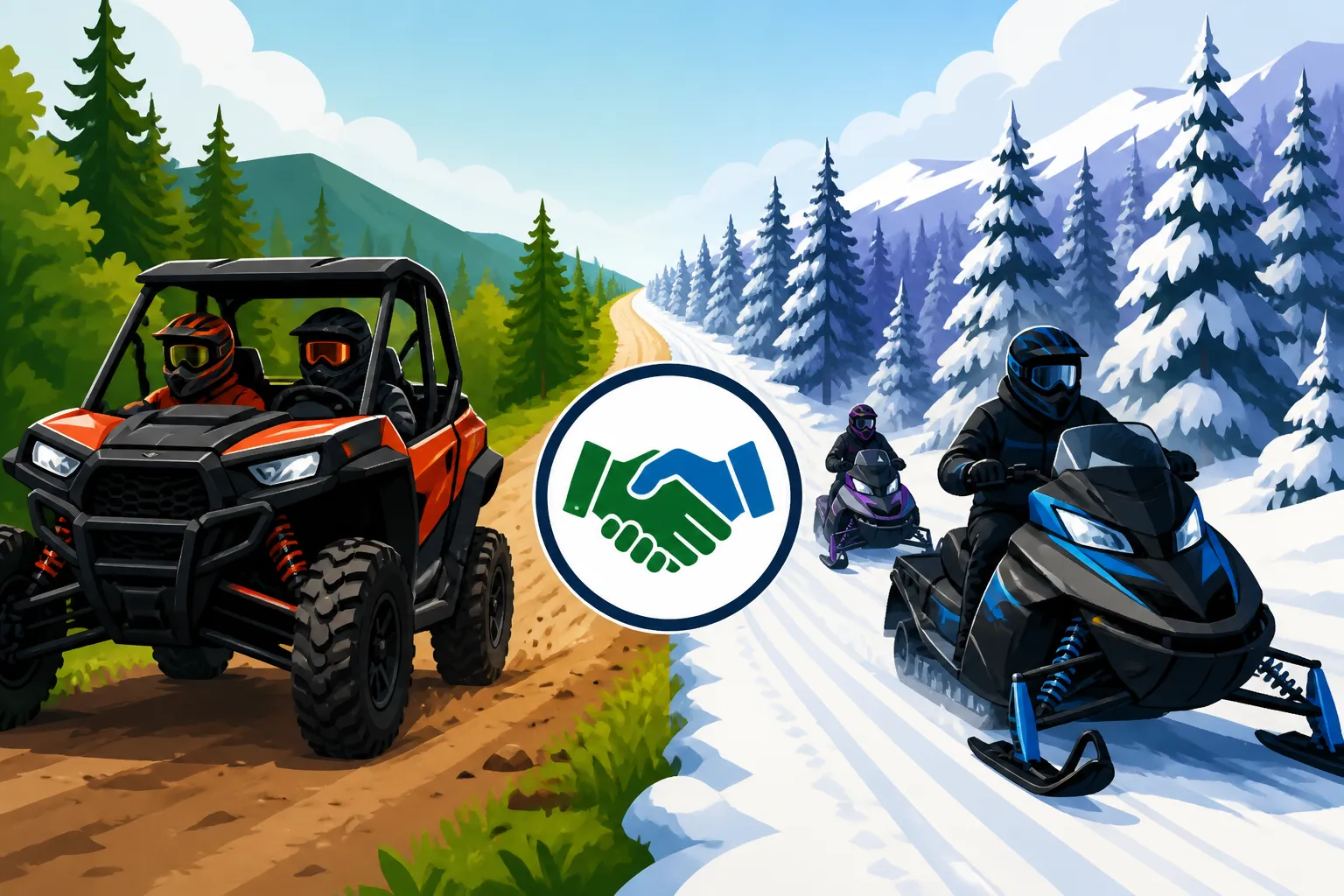
A shared corridor is a route or stretch of land used by different kinds of off-highway vehicles at different times. A club may prepare a route for wheeled OHRVs in warmer months and use the same corridor for snowmobiles after winter conditions arrive. The path may look similar on a map, but its permitted use can change with the season.
That distinction matters. A snowmobile trail is not automatically an ATV or UTV trail, and a trail used by ATVs in summer is not automatically open to wheeled machines in winter. The club’s current map, posted notices, gates and signs help show what is allowed. Landowner agreements and trail conditions can also affect access.
Think of “shared” as a description of how a corridor is managed over time, not a year-round pass. A route might be open to wheeled machines in one season, closed during a transition period, and then used by snowmobiles after sufficient snow and club preparation. Other routes may not permit both kinds of riding at all.
| What you see or hear | What it does and does not tell you |
|---|---|
| A trail appears on an ATV map and a snowmobile map | The route may serve both uses in different seasons. Check the current status before riding. |
| Snowmobile tracks or grooming equipment | The corridor is being used for winter recreation; that does not establish permission for an ATV or UTV. |
| A route was open last summer | It may now be closed, under winter management or unavailable because of conditions. |
| A trail is physically passable | Physical access is not proof that the trail is open to your machine. |
| A nearby trail is open to OHRVs | That does not automatically make every connecting snowmobile route open to wheeled vehicles. |
The most reliable question is not simply, “Is this trail on a map?” Ask: “Is this particular segment open to my type of machine today?” A route can cross club areas, town lines or different landowner parcels, and rules may change along the way.
For background on how seasonal uses fit together, see Why Two Seasons Share One Corridor and Trails That Carry Quads in Summer and Sleds in Winter. If you are trying to understand when snowmobile access affects the wheeled riding season, Why a Snowmobile Corridor Shuts in Summer explains why a corridor’s use can change.
Check the season, the segment and the club’s current status
Before heading out, check the map and trail-status information for the club or organization responsible for the area. A general map can help plan a route, but it may not reflect a temporary closure, a late opening, a washed-out section or a landowner’s change in access. Look for current notices close to your ride date.
Start with the trailhead you intend to use and trace your planned route section by section. Note where you will cross a town line, join another club’s network or approach a snowmobile corridor. A trail that is open on one side of a boundary may have a different status after the boundary. If the route depends on a connector, confirm that the connector is open too; otherwise, you may reach a dead end or have to turn around.
Pay particular attention to:
- Seasonal opening and closing notices. Clubs may open or close trails according to weather, ground conditions, maintenance needs and landowner arrangements. Calendar dates are not a substitute for a current status check.
- Gates and signs. A gate or closure notice takes priority over the fact that a route appears on an older map. Do not go around a barrier or assume a closed trail is passable by permission.
- Trail width and machine limits. Access may depend on the route and the machine. Check restrictions before taking a wide side-by-side onto a trail system.
- Connections between networks. A link between two trail systems may have a different manager or status from the trails on either side.
- Snowmobile infrastructure. Groomed surfaces, bridges, trail markers and other features may be managed for winter use. Do not treat them as evidence that summer OHRV use is allowed.
- Landowner access. Trails often rely on permission to cross private property. If access is withdrawn or limited, a route can close even when the trail itself remains visible.
When a status is unclear, contact the club responsible for that section instead of relying on an old screenshot, a third-party map or another rider’s account. Keep a backup route that stays on trails confirmed open for your machine. If a closure interrupts your plan, turn back rather than following a snowmobile trail to bypass it.
This is especially important during seasonal changeovers. A route can be too soft for wheeled machines even if snow has mostly disappeared, or it may be closed while a club prepares for winter use. Riding on soft or damaged ground can create ruts, increase repair work and put the club’s access agreement at risk. New Hampshire Trail Status Before You Ride and New Hampshire Trail Closures to Check First offer useful ways to plan around changing conditions.
Registration and permission are separate from trail access
Being registered does not make a closed corridor open. Registration is a separate requirement for riding on public OHRV trails in New Hampshire, while trail access depends on the route’s current designation, the season and any applicable landowner or club restrictions. A registered machine can still be on a closed or unauthorized trail.
New Hampshire does not use a separate statewide trail pass in place of OHRV registration. The registration is part of the requirements for riding on public trails, but it is not a guarantee that a specific corridor is open. For more on that distinction, see Why New Hampshire Sells No Separate Trail Sticker and Why Your Registration Is the Access.
Visitors should check the New Hampshire registration requirement before riding. A registration from a neighboring state does not automatically provide permission to ride New Hampshire trails. See Why New Hampshire Honors No Neighbor’s Registration and Riding New Hampshire With an Out-of-State Machine for the visitor-specific details. If you are deciding between a short visit and a longer riding season, The Ten-Day Option for a New Hampshire Visitor can help explain the temporary registration route.
Keep these two checks separate:
- Is the machine properly registered for New Hampshire riding?
- Is this specific trail open to this machine on this date?
You need the right answer to both. A sticker or certificate does not override a sign, a seasonal closure or a club’s current trail notice. And an open trail does not remove the registration requirement.
If you plan to ride through more than one club area, check whether each organization’s map and status information covers the whole route. Some clubs may publish conditions more frequently than others, so do not assume that one open-trail notice applies to every adjoining corridor. The same care is useful when a route approaches private property: public trail access does not authorize riding beyond the marked route or onto neighboring land. For the basic permission rules, see Written Permission on New Hampshire Private Land.
Ride the corridor as a guest of both trail systems
A corridor used in more than one season depends on careful coordination. Snowmobile clubs, OHRV clubs and landowners may share access arrangements, maintenance responsibilities or the same narrow passage through a property. Riders help preserve that access by following signs, staying on the marked route and respecting closures, even when the corridor appears quiet.
If you arrive and find snowmobile markers, equipment or a groomed surface, do not assume it is suitable for a wheeled machine. Use only a route specifically open to your type of OHRV, and avoid damaging trail features. If the corridor is closed to ATVs or UTVs, choose another confirmed route rather than trying to interpret the closure narrowly.
A few practical habits make a shared-corridor ride easier to manage:
- Check the responsible club’s latest status before leaving, not just when you first planned the trip.
- Save or download a current map, but remember that a map does not replace closure signs or live updates.
- Identify the club or land manager for each section of a longer route.
- Leave room in your schedule to turn around if a connection is closed.
- Do not ride around barriers, on an unmarked shoulder or beyond the marked trail to get past a closure.
- Avoid riding when the surface is soft enough to rut or damage.
- Report a missing sign, damaged gate or confusing closure notice to the organization responsible for the trail.
Trail clubs often maintain routes for different kinds of recreation across changing seasons. A summer trail may need to close before winter use, and a winter corridor may not be available to wheeled machines once snowmobile operations begin. Clubs That Groom in Winter and Ride in Summer describes the seasonal work that can shape access; Whether a Club Trail Allows Tracks in Winter is useful when you are asking about winter access for machines rather than sleds.
The simplest rule is to treat a shared corridor as seasonally managed, not universally open. Confirm the machine type, the route segment and the current status. Then check registration and any separate access conditions before setting out. That approach avoids the common mistake of assuming that a familiar trail—or a trail listed for another season—must be open to your ATV or UTV today.
Disclaimer
This article is for general informational purposes only and does not constitute professional advice. Laws, prices and regulations vary by location and change over time. Consult a qualified professional for guidance on your specific situation.