Crossing the Line Into Maine
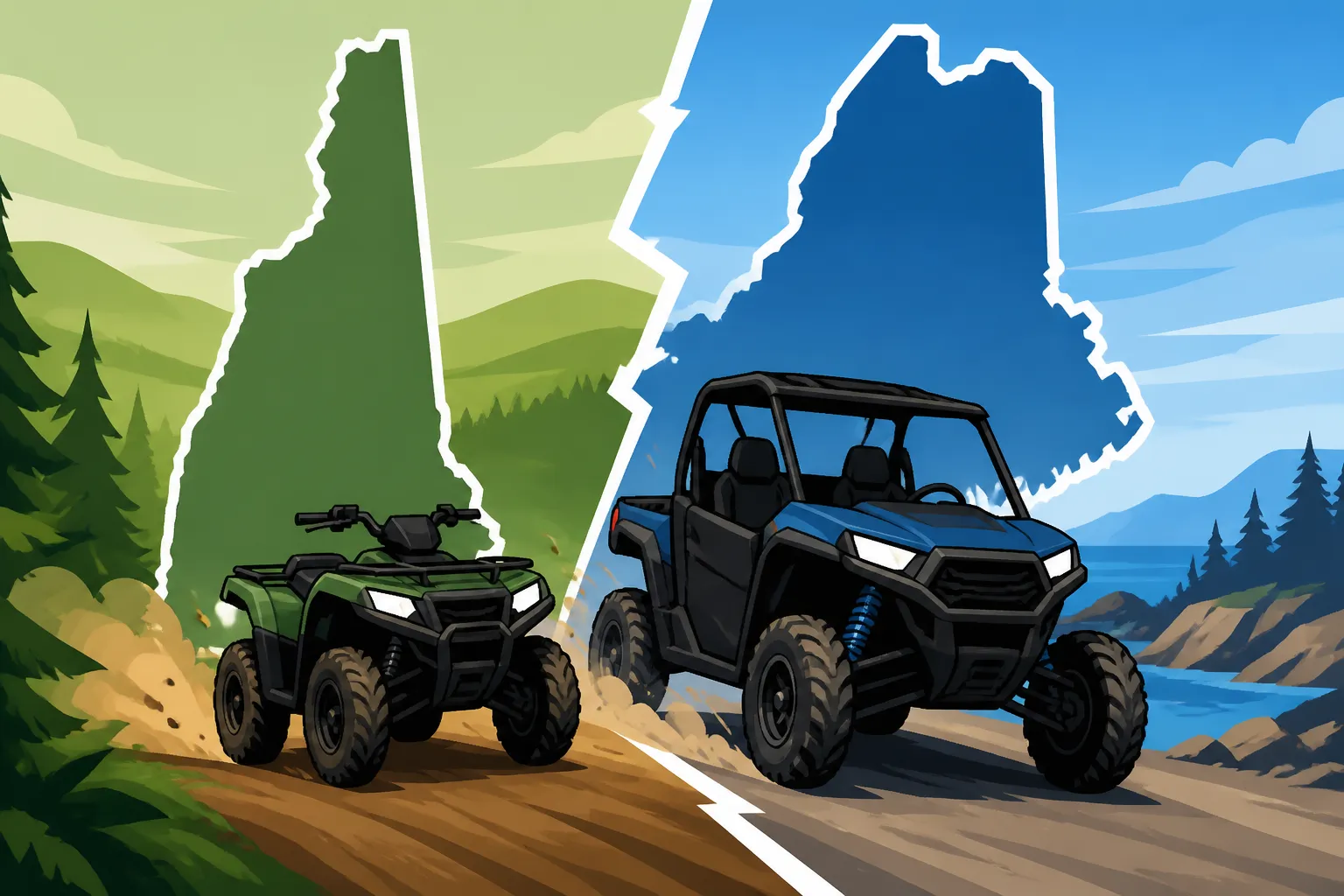
Crossing from New Hampshire into Maine on an ATV or UTV takes more than following a trail across the state line. Registration, trail access, and road-crossing rules can change as soon as you enter Maine. The safest plan is to confirm Maine’s requirements for your machine and route before departure, rather than assuming a New Hampshire registration or open trail carries across the border.
Check Maine registration before crossing
A New Hampshire OHRV registration is not a blanket permit to ride in Maine. Maine has its own registration rules, and a New Hampshire decal or certificate may not satisfy them. Before you ride, check Maine’s current requirements for a nonresident using an ATV or UTV, including whether your machine’s existing registration qualifies for any applicable exception.
Do not assume that registration works both ways just because the states share a border. New Hampshire requires visiting machines to meet New Hampshire registration rules, and Maine sets its own rules for machines entering from another state. The question of whether Maine accepts your New Hampshire registration is separate from whether New Hampshire accepts a Maine registration. See Why No Maine Registration Works in New Hampshire and Does New Hampshire Honor a Maine Registration? for the New Hampshire side of that distinction.
| Before you cross | What to verify |
|---|---|
| Your machine’s registration | Whether Maine requires a separate nonresident registration or recognizes your current registration |
| Machine category | How Maine classifies your ATV, UTV, side-by-side, or other off-highway vehicle |
| Registration proof | Which documents or decals you must carry or display |
| Planned trail route | Whether the route is open to your machine and connects legally across the border |
| Road sections | Whether the road or crossing is open to OHRVs and what rules apply |
| Current conditions | Seasonal openings, closures, and local restrictions |
The registration requirement applies to the machine, not just the person riding it. If you are borrowing a friend’s machine, confirm that its Maine paperwork is valid for the trip; your own registration does not automatically cover another vehicle. Likewise, a registration purchased for one machine should not be treated as permission to ride a second one. If your trip involves a borrowed machine or a change of vehicle, review Registering a Borrowed Machine in New Hampshire and confirm Maine’s separate requirements with the appropriate Maine authority.
Before setting out, identify the official Maine agency responsible for ATV registration and check its current instructions. Registration categories, accepted proof, authorized sales locations, and fees can change. If you cannot confirm that your New Hampshire registration is accepted for the planned use, treat Maine registration as necessary until the state confirms otherwise. Keep any receipt and registration documents with the machine, and make sure the required decals are attached as directed.
The same care applies if you have recently registered or transferred the machine in New Hampshire. A registration that is valid at home does not necessarily answer Maine’s requirements. For New Hampshire paperwork basics, see New Hampshire OHRV Registration Paperwork and Registering an Out-of-State Machine in New Hampshire. Use those details to check your New Hampshire documents, then verify Maine’s rules independently.
Confirm the trail is open on both sides
A line on a map does not guarantee a legal or open trail crossing. Trails on each side of the border may be managed by different clubs, landowners, or public agencies. A route that reaches the state line in New Hampshire might not continue as an authorized Maine trail, and a Maine trailhead may not connect to the trail you expect.
Plan the route as two linked trips: one on the New Hampshire side and one on the Maine side. Check current maps and trail-status notices for each area, and confirm that the connection is open to your machine. Width restrictions, seasonal closures, trail conditions, and local access rules may differ. Do not rely on an old map, a GPS track from another rider, or a line shown in a navigation app as proof of current permission.
Maine trail access can depend on landowner permission and the conditions set for a particular route. A club-maintained trail is not automatically open to every vehicle or available in every season. Respect gates, signs, and closures, and do not ride around a closed section to reach the next trail. The rules for private property matter on either side of the border; New Hampshire Written Permission Requirements explains the New Hampshire side, but permission for land in Maine must be established under Maine’s rules.
Before leaving, check for:
- A route that legally connects the New Hampshire trail system to the Maine trail you intend to use.
- Trail openings and closures for the day of your ride.
- Any machine-width or vehicle-type restrictions along the route.
- Private-land access conditions and signs.
- Road crossings or road segments that require separate authorization.
- A safe alternative if the connection is closed.
New Hampshire conditions can change quickly, especially during spring thaw or after heavy rain. A trail that was open on a previous visit may be closed now, and a Maine trail may follow a different calendar. Check New Hampshire Trail Status Before You Ride for the New Hampshire portion and look for current status information from the relevant Maine trail organization or land manager.
Do not confuse legal registration with trail access. A valid registration lets you meet a vehicle requirement; it does not grant permission to ride on every trail or parcel of land. New Hampshire does not have a separate general trail pass in the same sense as some riding areas, but that does not create permission to use Maine trails. Why New Hampshire Has No Separate Trail Pass covers that distinction for New Hampshire. In Maine, verify what access is included with the route or organization you plan to use.
Prepare for different road rules and local restrictions
The route may include a road crossing or a road segment, but a road that is open to OHRVs in New Hampshire is not necessarily open to them in Maine. Town designations and road rules are local, and road access should never be inferred from a trail connection alone. Confirm each road segment with the relevant town or local authority, and follow posted restrictions.
This is especially important when a route enters a village, passes through a parking area, or uses a road to connect two trail sections. A trail map may show the route but not explain every operating condition. Check whether OHRVs are allowed, where they may travel, and whether any time, speed, or equipment rules apply. New Hampshire’s town-road process is separate from Maine’s; New Hampshire Rules for Riding Across a Town Line explains why a crossing between towns can change the rules even without crossing a state border.
Make sure your machine is ready for the full route, not just the first trail. Carry enough fuel for the distance between confirmed stops, bring a map or navigation device with offline coverage, and plan for areas with weak cell service. A GPS line can help with navigation, but it cannot tell you whether a trail is open or whether you have permission to use it.
A practical pre-ride check:
- Confirm Maine’s current registration requirement for your machine and rider status.
- Gather the documents Maine requires and attach any required decals before riding.
- Confirm the route on both sides of the border using current trail information.
- Check access conditions for private land, road crossings, and trail connections.
- Tell someone your planned route and expected return time.
- Carry identification, registration proof, basic repair supplies, and a way to contact help where service is available.
If you are riding in a group, make sure every machine meets the requirements. One properly registered machine does not cover the rest of the group. Agree on the route and regrouping points before leaving, particularly if some riders are unfamiliar with the area. Keep the group together at junctions and do not let a rider follow an unverified track merely because it appears to connect with the main route.
Make the return trip part of the plan
Crossing into Maine does not remove your New Hampshire obligations when you return. Keep your New Hampshire registration current and carry the proof required for riding there. If you obtained a Maine registration for the trip, do not assume that it replaces New Hampshire registration on New Hampshire trails. The two states’ registration systems and access rules are separate.
Before turning back, check the route status again. A closure, weather change, landowner restriction, or trail condition may affect the return route even if the crossing was open earlier. Have a backup plan that does not involve riding a closed trail, using a road without authorization, or cutting across private land.
The most reliable approach is to confirm the details directly with the relevant state and local sources shortly before the ride. Ask specifically about your machine type, your nonresident status, the registration documents you carry, and the route you intend to use. For broader New Hampshire visitor requirements, Riding New Hampshire With an Out-of-State Machine and New Hampshire Rules for a Visiting Rider can help you plan the return portion. Maine requirements still need to be checked separately.
A little preparation prevents the common mistake of treating a border crossing as a simple extension of one trail system. Confirm registration first, verify the trail connection and land access, and check every road segment. If any part of the route or requirement remains unclear, choose a route you can verify rather than taking a chance on the state line.
Disclaimer
This article is for general informational purposes only and does not constitute professional advice. Laws, prices and regulations vary by location and change over time. Consult a qualified professional for guidance on your specific situation.